There’s nothing quite worse than waking up in the middle of the night to realize the furnace in your RV is not working. Your furnace is excellent at keeping your RV warm on cool summer nights and helping you extend your camping season into early spring or late fall. But you’ll need this RV furnace troubleshooting guide when it doesn’t work as anticipated.
You can always supplement your furnace by plugging a space heater for RV use into a non-GFCI circuit that can handle it. But that will only heat the living space, not the underbelly compartments or belly pan where your plumbing is located. So you eventually need to figure out why your RV heater isn’t working.
Whether you have a travel trailer, fifth wheel, or motorhome, if your RV furnace is not working, the cause usually comes down to power, propane, or airflow. This guide walks you through each one, then explains when it’s time to hand the job to a certified RV technician.
Technician Tip: Always play it safe when troubleshooting gas RV appliances. When in doubt, contact an RV furnace professional. Consult the owner’s manual for your furnace for model-specific troubleshooting tips. For a quick overview, learn more about RV heating systems.
What Is Normal RV Furnace Operation?

Let’s begin by defining what’s “normal” in the operation of a camper furnace. Learning how RV furnaces work will give you the background to troubleshoot more efficiently when the need arises.
Starting out, you must have propane; it must be connected to your furnace (typically through the RV’s built-in supply lines), and the valve on the top of your propane container(s) must be completely open. Then you must purge the system by lighting a stovetop burner before turning on the RV furnace and setting the thermostat to a temperature higher than the ambient air temperature inside your RV.
When you’ve completed those steps, the following sequence occurs when the gas furnace in your RV is functioning properly:
- The fan turns on first
- Within 5-10 seconds, you should hear the click of the igniter followed by the sound of the burner being lit
- Another 20-45 seconds later, you should feel warm air coming from the furnace vent(s). Exact timing varies by model.
Technician Tip: Check the outside furnace vent for the free flow of exhaust gases.
Find your furnace termination vents outside (usually chrome pipes with hot warnings imprinted on the trim ring). Stand back and extend your hand 12 to 18 inches away from the pipe opening. You should easily feel a steady, warm stream of air blowing against your palm without needing to get closer. In cold weather, you should see visible water vapor (steam) steadily exiting the pipe.
RV Furnace Troubleshooting For When It’s “Not Normal”
Again, your owner’s manual is your best source for RV furnace troubleshooting advice. Here are five of the most common issues RVers experience when their camper’s furnace isn’t working:
- Nothing happens when I turn on my furnace
- The blower turns on, but my furnace does not ignite
- The furnace cycles frequently
- The furnace doesn’t shut off
- My furnace is blowing cold air
Let’s cover the potential causes and troubleshooting paths you can take for each of these common issues
1: Nothing happens when I turn my camper’s furnace on

You’ve confirmed your furnace is turned on, but nothing is happening.
The first potential cause is that your thermostat is simply set too low.
Set the thermostat to a temperature higher than the ambient temperature inside your RV, and listen for the fan to start blowing. If not?
The next potential cause is low battery voltage.
To eliminate low battery voltage as a potential cause, you can:
- Check battery connections for corrosion (recommended at least once a month)
- Check battery levels
- Recharge the battery if the output is below 12 volts
A third potential cause is the sail switch getting stuck.
This typically happens when debris (dust, dirt, pet hair, etc.) builds up and holds the contacts closed. It can sometimes be freed by jarring the furnace, but accessing the switch to clear the debris isn’t always simple, depending on your RV’s design. It can also be caused by a mechanical failure of the switch itself. If you suspect mechanical failure, or the unit needs to be disconnected for access, a certified technician is best equipped for these jobs.
Another potential cause is a blown fuse.
To check this, inspect the 12-volt DC fuse in your RV’s distribution panel. If blown, replace it with one of the same size and type. Some furnaces also have their own fuse on the control board, so check your owner’s manual for its location. However, if a fuse blows, something has caused it.
Troubleshooting the cause of a blown fuse on an RV furnace is vital before continuing. That’s where you may need the assistance of a certified RV technician.
2: The RV furnace blower comes on, but won’t ignite
You’ve turned your furnace on and adjusted the thermostat as recommended above. The blower motor comes on to power the fan, but no ignition occurs, and the fan then shuts off. In other words, the RV furnace igniter is not clicking.
The first potential cause to investigate is a lack of propane.
This could be caused by an insufficient propane supply or a closed propane valve on top of your container(s).
Take the following steps to investigate this potential cause:
- Turn off the furnace
- Check your propane container levels
- Ensure the tank valve is completely open
- Light a stovetop burner to test LP flow; allow it to burn for 20 to 45 seconds.
- Turn on the furnace and adjust the thermostat to retest
If propane supply isn’t the issue?
The next potential cause is air built up in the propane supply line.
This can happen between uses when the propane supply is shut off at the container valves.
To check and/or remedy this issue:
- Turn off the furnace
- Turn on and ignite one of your stovetop burners
- Allow that appliance to run for 20 to 45 seconds to fill the line with gas
- Shut off and retest the furnace
Still not getting ignition?
The next potential cause is insufficient airflow.
This is most often caused by a sail switch being stuck in the open position, which can often be resolved by jarring the furnace. Follow these additional steps to check that your RV furnace is getting enough airflow for safe ignition:
- Turn off the furnace
- Check the air intake on the exterior of your RV
- Clean it out if blocked with leaves, dirt, or other debris
Now that you’ve eliminated propane supply, air buildup, and insufficient airflow, what’s next?
Another potential cause of a furnace failing to ignite is a broken igniter.
To check your igniter’s condition, ask yourself the following question:
- Do you hear the igniter click after the blower has been running for 5-10 seconds?
If yes:
The igniter is functioning properly, and you may have another cause (i.e., a lack of propane or air in the propane lines).
If no:
The igniter may be bad. But before jumping to that conclusion, it’s worth checking the sail switch and the high-voltage igniter circuit. A sticking sail switch can sometimes be freed by jarring the furnace. If the igniter relay on the circuit board is supplying power, you may have a bad igniter coil.
But here’s where we start to require the expertise of a certified RV technician. Why?
The final potential causes of a failure to ignite are a failing sail or high-limit switch, a failing gas valve, or a failing igniter control circuit board.
With all these potential causes, your safest course of action is to contact your nearest RV service center or a mobile RV mechanic to schedule a comprehensive diagnostic.
3: My camper’s furnace cycles frequently

Your camper’s gas furnace is turning on and blowing hot air, but it’s cycling on and off more frequently than it should – or at least more frequently than in the past.
The easiest potential cause of a frequently cycling furnace is drafts coming from worn door or window seals.
Cool air from leaky windows and doors can cause your thermostat to cycle on more frequently than necessary. Check the seals around all doors and windows near the thermostat to eliminate drafts when heating an RV.
Ensure that no rugs or blankets cover the floor registers, and that an ice chest or suitcase does not block the return air vent, as these can restrict airflow and cause the furnace to overheat, resulting in short cycling.
Additionally, if the furnace duct is misaligned and pointing towards your thermostat, warm air will rise around the thermostat, causing it to shut off even if the rest of your RV is below its temperature setting. Check the furnace duct position and realign if necessary.
Finally, try turning on a vent fan or the fan function on your air conditioner to circulate air more evenly through your RV.
The next potential cause is a faulty thermostat.
To check your thermostat’s operation:
- Check the voltage at the thermostat by removing it from the wall and using your voltmeter. Wiring varies by your thermostat’s make and model; having a copy of the installation manual will help. With your meter set to DC volts, place your black probe on the thermostat’s known-good ground (usually blue) and your red probe on the 12 VDC positive wire (usually red). If you read 12 VDC, then we know the thermostat has sufficient power to operate.
- To test the operation, set the thermostat to HEAT and raise the temperature as high as it will go.
- Set the multimeter to DC volts. Place the black probe on the ground wire and the red probe on the wire labeled for the furnace, if present.
If you measure approximately 12 volts, the thermostat is not the problem. If you do not measure 12 volts, check for a removable fuse on the thermostat or in the circuit. If the fuse is blown, replace it with the correct size and type. If there is no fuse, or the fuse is good and you still do not measure 12 volts, the thermostat is likely the problem.
The remedy for this issue is to replace the thermostat with an identical model. Fortunately, we have a comprehensive tutorial to help you replace an RV thermostat.
- If voltage isn’t present, you may have an electrical short or open circuit in the system.
You can also check your RV’s fuse box.
- If the fuse is blown, replace it with one of the same size and type and retest.
- If the fuse isn’t blown, you may have a shorted wire or a faulty fuse.
If your RV furnace troubleshooting efforts leave you worried about an electrical short or a faulty fuse, your safest course of action is to consult a certified RV technician.
4: The RV furnace doesn’t shut off

Your RV gas furnace doesn’t have any issues turning on and producing heated air, but it’s not shutting off (which is a major safety red flag!). Keep in mind that, under normal operating conditions, the furnace will run for about two minutes after it’s turned off to allow the heat exchanger to cool down.
The likely cause is a faulty thermostat or time delay relay.
This requires the same voltage testing outlined in the previous section. Additionally, you can check the fuse box on your RV’s distribution panel.
- If the fuse is blown, replace it with one of the same size and type and retest.
- If the fuse isn’t blown, you may have an open circuit or a faulty fuse.
If you’ve exhausted these RV furnace troubleshooting tips and you’re worried about an electrical short or a faulty fuse, your safest course of action is to consult a certified RV technician.
5: My RV furnace is blowing cold air
Your camper’s furnace fan is running, and air is coming out of the vents, but it’s cold. Or the burner lights for a moment, goes out, and the fan keeps blowing. This is different from the second issue above, where the blower shuts off after a failed ignition attempt.
First, make sure it isn’t normal operation.
As covered above, the fan always starts before the burner lights, so a few seconds of cool air at startup is expected. The blower also keeps running briefly after the burner shuts off to cool the furnace. If the air turns warm within about 20 to 45 seconds of startup, or the cool air stops shortly after the burner cycles off, your furnace is working as designed.
The next potential cause is that the burner isn’t lighting.
If the fan runs but you never hear the igniter click or the burner light, work through the propane supply, air-in-the-line, and airflow checks in the second issue above. Your furnace can’t produce heat without a steady supply of propane. If this happens, the furnace blower should shut down after 20-30 seconds.
Another potential cause is an ignition lockout.
Most RV furnaces make several attempts to light (typically three) before the control board locks out further attempts as a safety measure. Depending on the model, the blower may keep running for a few minutes after a lockout, which feels exactly like a furnace blowing cold air.
Resetting the furnace (see below) clears the lockout. If it locks out again, something is preventing ignition, and it’s time to call a technician.
Finally, check for blocked or damaged ductwork.
If warm air reaches some vents but not others, a duct may be crushed, disconnected, or blocked by debris or a nest built during storage. Check any accessible duct runs and make sure no floor registers are covered.
Should you turn your furnace off if it’s blowing cold air? Once you’ve ruled out the normal startup and cool-down cycle, yes. Turn it off so the blower doesn’t keep draining your battery while you troubleshoot.
How To Reset an RV Furnace
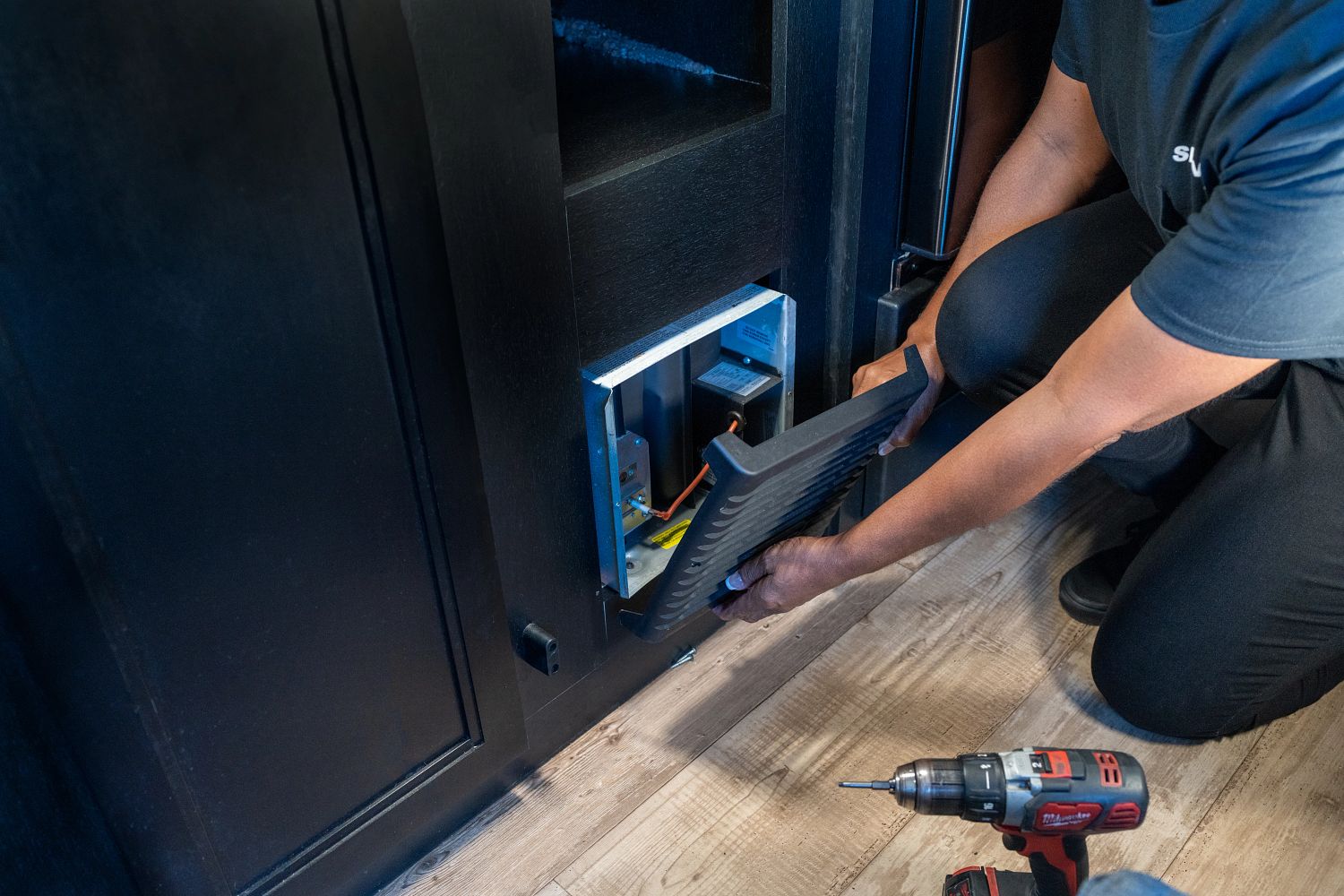
Most RV furnaces don’t have a dedicated reset button like many home furnaces. Instead, you reset an RV furnace by cycling its power, which also clears an ignition lockout.
If you’re looking for the reset button, look for the furnace’s power switch instead. It’s usually on the furnace itself, behind the interior access cover, and on some models it sits near the control board inside the furnace cabinet. Your owner’s manual will show the exact spot for your model.
To reset most RV furnaces, you’ll simply turn off the power switch, wait about 10 seconds, and turn it back on. If your model doesn’t have a power switch, pull the fuse to the furnace, wait 10 seconds, and replace it.
This is why it’s important to have your RV’s circuit breaker panel properly labeled. On many models, turning the thermostat off for about 30 seconds, then back on, will also clear a lockout.
Learn more about troubleshooting RV circuit breakers.
When Troubleshooting Doesn’t Work
If you’ve worked through these steps and your RV furnace still isn’t working, it’s time to call a professional. By this point, you’ve confirmed:
- You have propane in your containers, and the valves are fully open
- Your battery voltage is adequate, and no fuses are blown or breakers tripped
- The exterior intake and exhaust vents and the interior return-air vent are clear
- The thermostat is set to heat and above the temperature inside your RV
- You’ve reset the furnace
The remaining causes are within the furnace itself and usually require test equipment, access to the gas valve, or both.
Stop troubleshooting and turn off your furnace if your carbon monoxide (CO) or propane alarm sounds, you smell propane, you see soot around the exterior furnace vent, or you smell burning plastic or wiring. If you smell propane, also shut off the supply at the container and get everyone out of the RV. If your CO alarm sounds, get everyone into fresh air and call 911 if anyone feels dizzy, nauseous, or has a headache.
Technician Tip: A new and unused furnace may trigger the LP/CO alarm during the first 20 minutes of operation. Manufacturers call this the “burn off period.”
Camping World’s certified technicians can diagnose and repair RV furnaces from all major brands, including Dometic®, Atwood®, and Suburban®. Mobile service is also available at select locations.
Frequently Asked Questions
If your furnace shuts down repeatedly after running for a while, its high-limit switch may be doing its job. This safety switch shuts off the burner when the furnace gets too hot, usually due to restricted airflow from a blocked return-air vent, covered floor registers, or a dirty blower. Clear any obstructions and retest. Never bypass or jumper a limit switch, even to test it. If it keeps tripping with clear airflow, have the furnace inspected.
Most RV furnace problems come down to power, propane, or airflow. Low battery voltage, an empty propane container or closed valve, and a blocked intake or exhaust vent are the most common causes. A sticking sail switch is the most common cause of a furnace that blows air but will not light. Check these first before suspecting a failed component.
Call a certified RV technician at an RV service center or a mobile RV service provider. Camping World Service Centers repair RV furnaces from all major brands, and mobile service is available at select locations.
In addition to understanding these troubleshooting tips, read our guide to keeping your furnace in good working order.
Have questions about your furnace? Good Sam Elite members can call the Technical Support hotline at 844-649-4700 for questions and maintenance tips.
Are you experiencing other furnace issues? Let us know in the comments below!
The post RV Furnace Not Working? A Troubleshooting Guide appeared first on Camping World Blog.