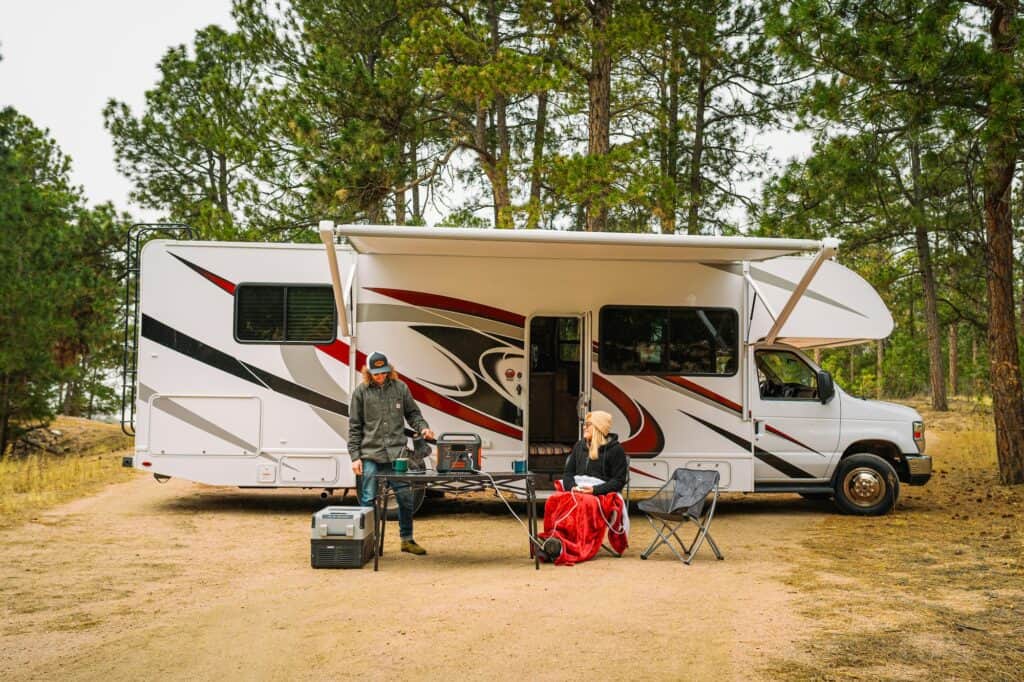
A Portable Power Station Helps You Relax
Are you looking for a simple way to meet your boondocking power needs without having to fire up a noisy generator?
A portable power station can give you clean, quiet off-grid energy without the hassles that come with using a generator.
Not only that, but most power stations offer versatile charging options. These relatively compact units don’t take up a lot of space.
Since portable power stations don’t require any venting, they can be carried in either interior or exterior cabinets, with no worries.
Many portable power stations can be used indoors or outdoors, so you can have electrical power without running any extension cords.
But one of the biggest advantages of portable power stations is that they’re so versatile. They offer a range of sizes to meet diverse power needs.
Sometimes referred to as portable battery generators, portable power stations offer versatile charging from a variety of sources.
That means you can use any 120-volt AC or 12-volt DC power supply or a solar panel to charge one.
Here’s the breakdown of all the advantages portable power stations offer:
Advantages of Portable Power Stations
- Clean energy
- Potentially free electricity
- Small, relatively lightweight, and easy to travel with
- Can be charged from different sources
- Quiet operation
- No fuel required
- Can be stored anywhere in the RV
- Versatile design includes multiple outlets for powering appliances or charging devices
- No changing oil or oil filters as on a generator
- Some larger models can run high-input appliances like air conditioners or microwaves
Disadvantages of Portable Power Stations
- Can be heavy, depending on the size
- Up front cost can be expensive
Key Features to Consider When Choosing An RV Power Station
Everybody uses their RV differently. We all have different needs when it comes to how we’ll use a portable power station.
For example, if you’ll be using it for powering a coffee grinder and recharging electronic devices, you’ll have much lower electrical needs than someone who uses their portable power bank to power a small refrigerator.
In light of that, there are a number of features you’ll want to consider in order to make an informed decision.
1. Capacity (Wh: Watt-hours)
This is perhaps the most crucial factor. In simple terms, capacity determines how long your power station can run your devices.
Think about which devices you plan to power and for how long. Here are some guidelines to help you decide what you need.
- Small capacity (200–500 Wh): Ideal for charging phones, tablets, and small lights.
- Medium capacity (500–1,500 Wh): Suitable for powering coffee grinders, mini-fridges, pressure cookers, charging larger electronic like laptops, and operating multiple devices for extended periods.
- Large capacity (1,500+ Wh): Best for running larger appliances, air conditioners, and possibly providing significant off-grid power for days.
2. Power Output (Watts)
Wattage indicates the maximum output power the station can deliver.
To decide how much wattage you need, find out the wattage of your most power-hungry appliances and start there.
Consider that you might be using power for multiple devices at the same time, too. Here are a few common examples:
- Coffee Maker: 800–1,400 watts
- Blender: 300–500 watts
- Space Heater: 750–1,500 watts
- Laptop: 50 watts
- Coffee Grinder: 300 watts
- 32-inch LED TV: 20 watts
3. Output Ports (AC, DC, USB)
Most portable power stations offer a variety of outlets and ports to meet different power needs.
Usually, they’ll have a 120-volt AC Outlet, and a 12-volt DC port, as well as USB and USB-C ports that allow you to charge electronic devices and laptops quickly.
- 120-volt AC Outlets: For standard household appliances (look for a pure sine wave inverter for RV for sensitive electronics).
- 12-volt DC Ports: For powering electronic devices.
- USB-A & USB-C Ports: For charging phones, tablets, and laptops. Power delivery is fastest with these ports and devices charge quickly
4. LiFePO4 Battery Versus Lithium Ion Battery
Portable power stations store power in either lithium Ion or LiFePO4 batteries. Each of these types of batteries has its own upsides and downsides.
For example, lithium Ion batteries are lighter, but they also have a much shorter lifespan than their LiFePO4 counterparts.
Because of their chemical and mechanical structure, they can also be more prone the overheating.
On the other hand, LiFePO4 batteries are phosphate-based, offering a safer and more durable chemical and mechanical structure.
Due to their chemical composition, they don’t tend to overheat and they last much longer than their lithium Ion counterparts.
With that said, LiFePO4 is definitely the preferred technology for RV portable power stations.
5. Recharging Options
AC power is the fastest way to recharge a portable power station. However, the hard truth of boondocking in an RV is that we don’t have access to AC power.
That said, it’s good to have options.
So portable power stations usually have three charging options: AC (120-volt wall outlet), 12-volt DC car outlet, and solar panel input.
Look for a power station with an efficient MPPT (Maximum Power Point Tracking) solar charge controller.
6. Portability and Durability
It’s a good idea to choose a portable power station that seamlessly fits into your RV.
Also, know how much you’re capable of lifting and packing into a storage space easily.
Smaller portable power stations offer surprising performance in a much lightweight format. On the other hand, larger portable power stations can be pretty heavy.
7. Waterproof/dust proof IP Rating
Portable power stations are rated for outdoor use with an IP rating. For instance, An IP score of IP4 means a device is safe from splashes of water.
However, an IP rating of IP65 or IP67 means the unit is sealed against dust intrusion, but can also withstand a jet of water from a hose.
If you’ll be transporting your portable power station in the bed of a truck or using it outdoors where it might rain, it makes sense to get a portable power station with a higher IP rating.
Embrace the Portable Power Revolution
As technology advances, portable power solutions for RVs are becoming lighter, more affordable, and a lot more powerful.
Investing in a high-quality portable power station is not just about convenience; it’s about embracing a more sustainable, independent, and enjoyable RV lifestyle.
The post The RVer’s Guide to Choosing the Right Portable Power Station appeared first on RV LIFE.