SEASONED RV EXPERTS and first-time owners alike can find travel trailer towing stressful. Even with experience, there can be variables you simply can’t account for. However, you can control a lot, and learning to drive with a trailer will reduce stress and help you relax and enjoy your camping adventures.
In this guide, we’ll cover towing preparation tips, road etiquette basics, advice on what to do when it gets windy, and more—with pointers for RV experts and those towing a travel trailer for the first time.
Key Takeaways
- Prioritize Mechanical Preparation: Safety starts before driving by ensuring your vehicle’s tow capacity exceeds the trailer’s weight, using weight distribution hitches, and performing pre-trip checks of tire pressure and signal lights.
- Master Vehicle Handling: Drivers should practice maneuvers in empty lots to become accustomed to their trailer’s wider turning radius and height clearance. On the highway, they should maintain a lower speed (60–65 mph) to account for longer stopping distances.
- Manage Environmental Factors: Maintain safety by pulling over during high winds (30+ mph), using engine braking on mountain descents to prevent brake failure, and utilizing RV-specific GPS or apps to plan routes and fuel stops that accommodate large rigs.
Know the Importance of Travel Trailer Towing Safety
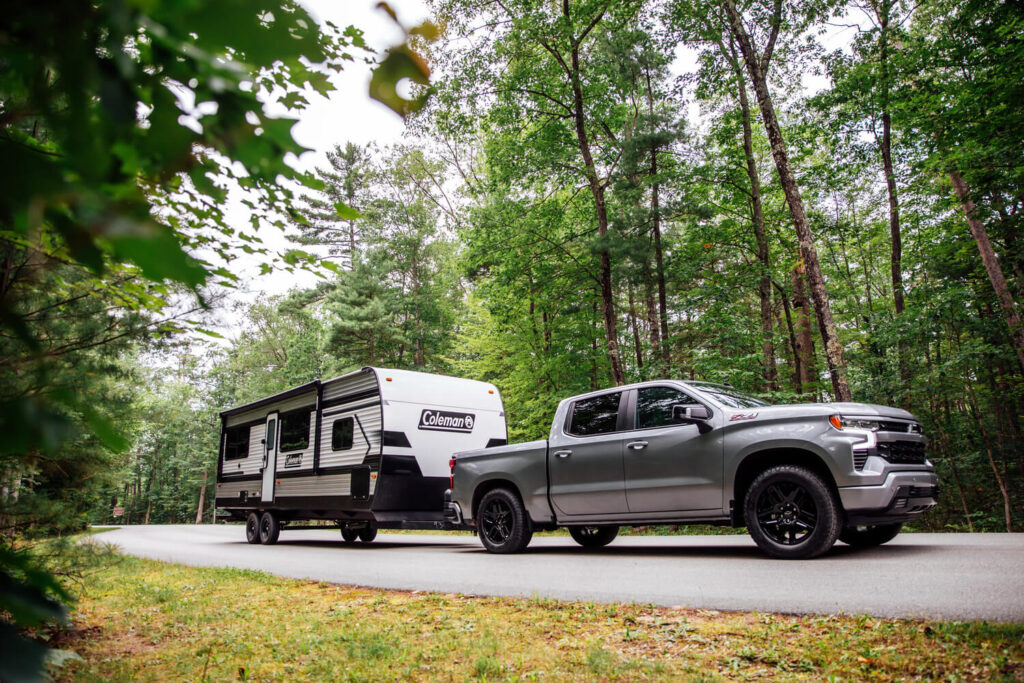
With the right preparation, towing doesn’t have to be stressful. However, a lack of preparation almost always has consequences. There is a lot to be aware of if you’re new to towing a travel trailer, but most new RV owners manage the learning curve within a few trips.
Towing a camper isn’t something to take lightly. Failing to respect the challenges involved can damage your camper and tow vehicle and, in the worst cases, put you and your passengers at risk.
RV drivers must be aware of, and do their best to avoid, bridges with low clearance, tight turns, fast food drive-thrus, and, of course, other drivers. Knowing how to safely tow a travel trailer protects you, your investment, and others on the road.
Prep Your Trailer for Safe Towing
Your first order of business starts well before you climb behind the wheel. You must know how much you can tow, how to load and hook up your trailer, and how to choose the right towing accessories to maximize your safety. Luckily, there are many resources to help you prepare for safe camping towing:
- Understand RV trailer weight ratings and how they impact towing safety.
- Ensure that your towing capacity exceeds your trailer’s gross vehicle weight rating.
- Learn how loading trailers properly helps you adhere to the 60/40 rule.
- Become familiar with the steps for correctly hooking a trailer to a hitch.
- Know the importance of a trailer weight distribution system.
- Consider whether a trailer brake controller is required for your setup.
- See why an RV technician should install a weight distribution hitch (not just anyone!).
- Understand how to adjust a weight distribution hitch once it’s installed.
The resources above will help you maximize the safety of your trailer-towing setup. They’ll also help you secure your trailer to your tow vehicle and load it properly.
From there, you’ll need to check turn signals, running lights, brake lights, and hazard signals. You may need a spotter to help with this.
Furthermore, take the extra time to check the air pressure in all tires (trailer and tow vehicle). These should be adjusted according to the manufacturer’s recommendations. Towing with under-inflated or over-inflated tires increases your odds of suffering a blowout, and under-inflated tires also reduce your fuel economy.
If you don’t already have a tow vehicle, read this guide to the best vehicles for towing.
Learn Your Trailer’s Size
Most trailers are wider than common tow vehicles. That’s why some owners use tow mirror extenders for added visibility. This is always a wise investment to help you tow safely.
Length and height matter, too. If you’re new to towing, take your trailer to an empty parking lot and practice before you hit the open road.
Practice Pulling Your Camper
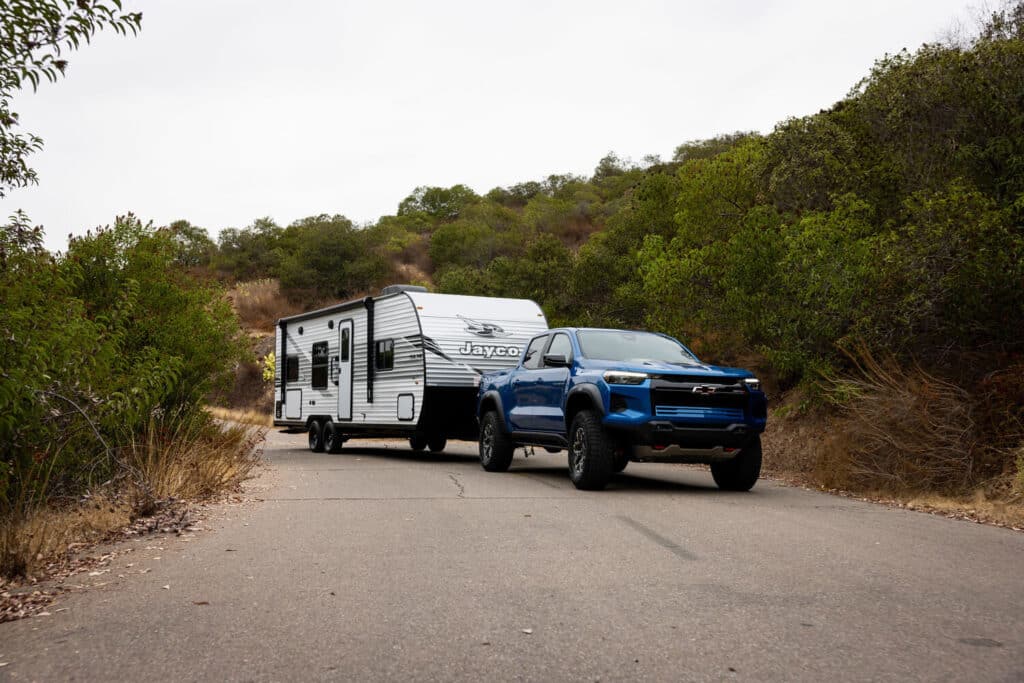
Ideally, find a lot with a few light poles scattered throughout so you can practice navigating around and between them. Take care to swing wide when making turns. The arc of your trailer’s rear bumper will be smaller than the arc of your tow vehicle’s front bumper.
Pay close attention to how your trailer follows your tow vehicle and observe how wide you need to swing when turning around obstacles. Go slow as you’re practicing and be aware of the lean of your trailer when you turn.
Street signs and traffic signals sometimes hang over the roadway. So being aware of your trailer’s turning radius will help you avoid these obstacles. Also, practice pulling into parking spots forward and in reverse. It’s helpful to practice backing in a travel trailer several times before watchful eyes are on you at an RV park.
Know Your Travel Trailer’s Height

Measure the height of your trailer or find it in your owner’s manual. Post that height on a sticky note somewhere you can see it while driving. That will remind you how much clearance you need when going under bridges and overpasses.
To avoid height issues altogether, map out the best route for towing a trailer to your preferred destination before you leave. Use an RV GPS system to plan a safe, friendly route that avoids low clearances, road construction, and other obstacles. This will help you avoid detours that add hours to your driving time.
Follow Road Etiquette Driving a Travel Trailer

There are many RV driving rules to be aware of before setting out. Here is a quick summary of general travel trailer etiquette:
- Use the right lanes unless turning, passing, or entering/exiting a roadway.
- If you’re brand new to towing, avoid passing until you feel more comfortable.
- On single-lane roads with no passing lane, pull over and allow vehicles to pass if there are four or more following closely behind you.
- Signal your turns and lane shifts early to alert other drivers.
- Follow all posted speed limits and traffic signals.
Use Appropriate Speeds
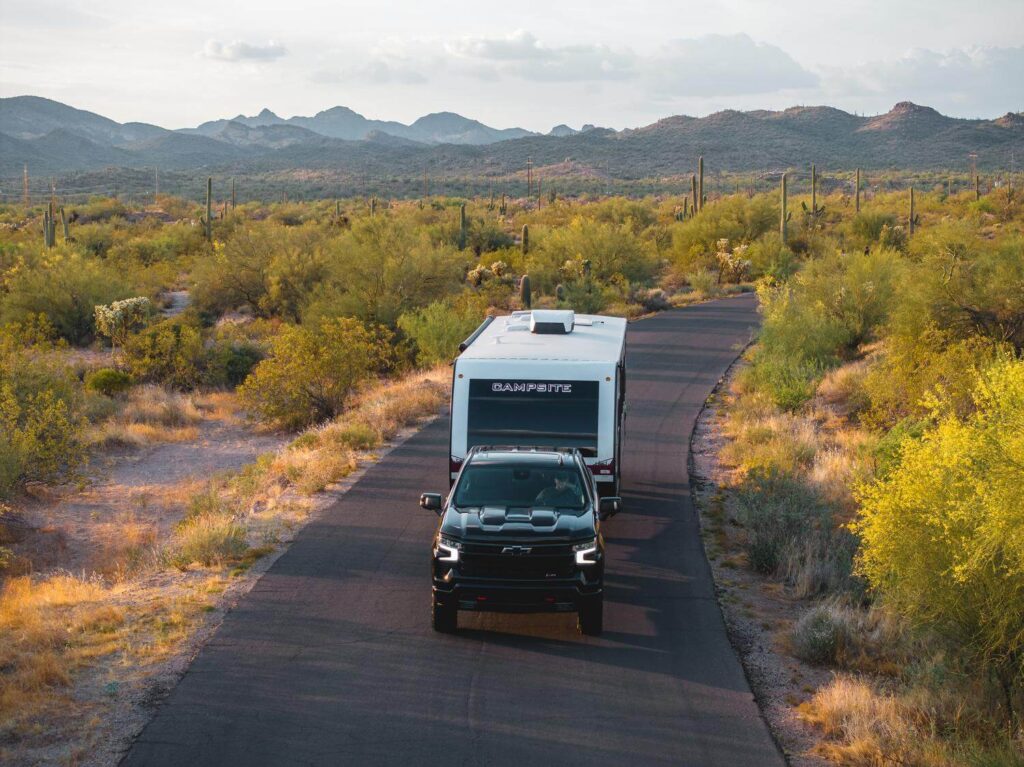
Speaking of speed limits, what is an appropriate speed for towing a travel trailer? Many experts and long-time RV owners recommend reducing your normal speed by 10 to 20 miles per hour when towing. That means 60-65 instead of 70-75 on major highways, depending on the posted limits. Reducing your speed further on smaller, windier roads is also recommended, as is paying closer attention to the yellow speed recommendations on sharper curves and steeper grades.
Most trailer tires are rated for 60 to 65 miles per hour. Fortunately, there are some silver linings to traveling a bit slower, such as potential fuel savings, less gear movement in your trailer, and less wear on your trailer and vehicle brakes.
Towing more slowly helps to ensure that you, your trailer, and your camping gear arrive at your destination no worse for wear.
Increase Following Distance for Safe Slowing & Stopping
Using appropriate speeds also comes into play when slowing your trailer down. Your vehicle and trailer need 2-3 times as much distance to slow down and stop as your vehicle alone.
The faster you go, the longer (and further) it will take to slow down. This is true even for travel trailers with electronic brake controllers, which takes some burden off your tow vehicle’s brakes. It’s why increasing your normal following distance by one second for every 10 feet of your combined vehicle and trailer length is a smart idea when towing.
Know When to Get Off the Road

Wind and weather can significantly affect towing safety. In regard to wind, you’re basically driving a large sail down the road—it will be affected by the wind much more than your tow vehicle.
Crosswinds are more dangerous than headwinds or tailwinds. When you feel the wind pushing you left or right as you drive, gently steer into it to keep going straight. Depending on the size of your trailer, even minor crosswinds of 10 to 15 miles per hour can impact your steering.
While there’s no set rule for how much wind is too much when towing a camper, you’ll need to begin exercising caution when wind speeds climb about 20 mph. When they exceed 30 mph, even if it’s just occasional gusts, it’s smart to pull over and wait things out.
Heed all posted wind warnings along your driving route. If a posted recommendation suggests doing so, or you feel uncomfortable continuing to drive, pull over and wait until conditions improve.
Tips for Driving in Inclement Weather
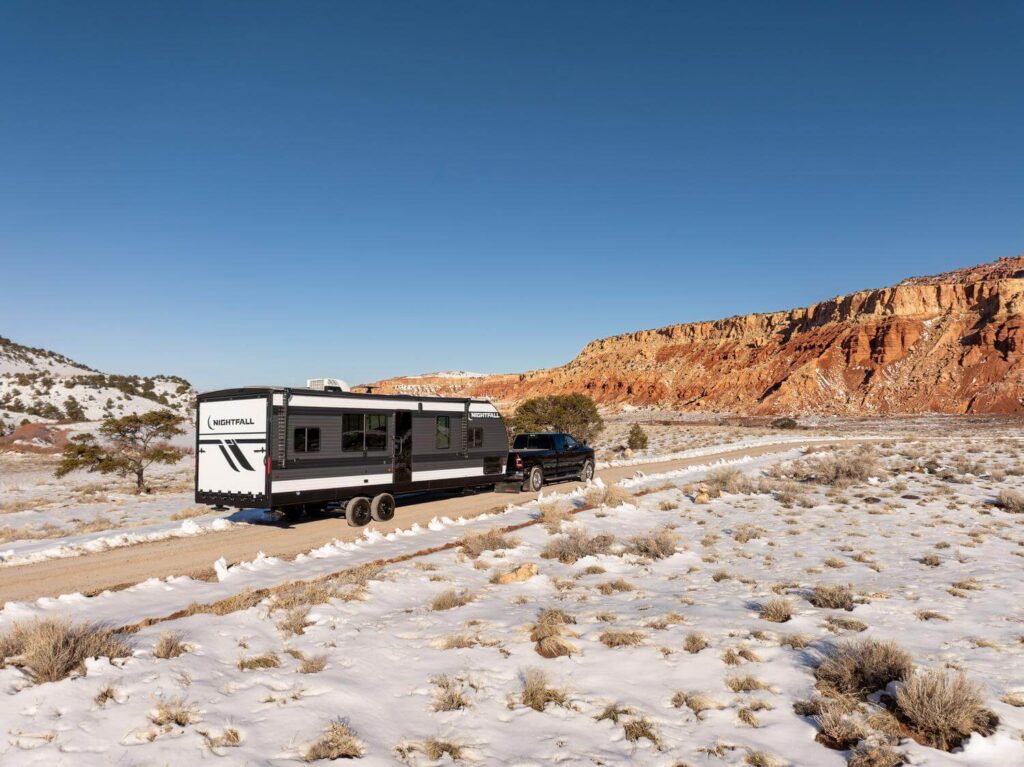
Wind isn’t the only weather concern. Rain, snow, ice, fog, and poor visibility can all impact towing safety—and may be reason enough to reconsider your drive.
Use your preferred weather app to check the weather frequently along your route. Radio stations broadcasting road alerts and weather warnings along your route are another excellent resource. As a rule, if the lights on those road condition signs are flashing, tune in to the advertised station to learn why.
Just like the wind, it’s better to pull off and wait for a storm to pass than to drive into unsafe conditions.
Handle The “Pull” of Large Vehicles

In addition to the wind, towing a camper means contending with the pull of other RVs, semi-trucks, and other large vehicles you pass. This happens when two large vehicles are moving in opposite directions, and the effect is greatest on two-lane roads without a center median.
As a driver, you’ll feel your tow vehicle and trailer pulled towards oncoming traffic. To be clear, you DO NOT need to overcorrect in this scenario. On calm days, slightly steering away from oncoming traffic will suffice, but you will need to gently correct once the vehicle has passed.
This effect increases in windy conditions. If you’re dealing with a crosswind from left to right, for example, you’ll already be steering slightly towards oncoming traffic to keep your trailer straight.
When a semi-truck passes, it acts as a momentary windbreak. To correct, gently reduce the amount you’re steering into the wind, then correct once the truck passes.
This effect can be subtle and may not require major adjustments to your steering wheel orientation. Reducing your speed can also minimize the impact when passing large trucks and other RVs. If at any time you feel unsafe on the road, pull over and take a break.
Tow More Carefully in the Mountains
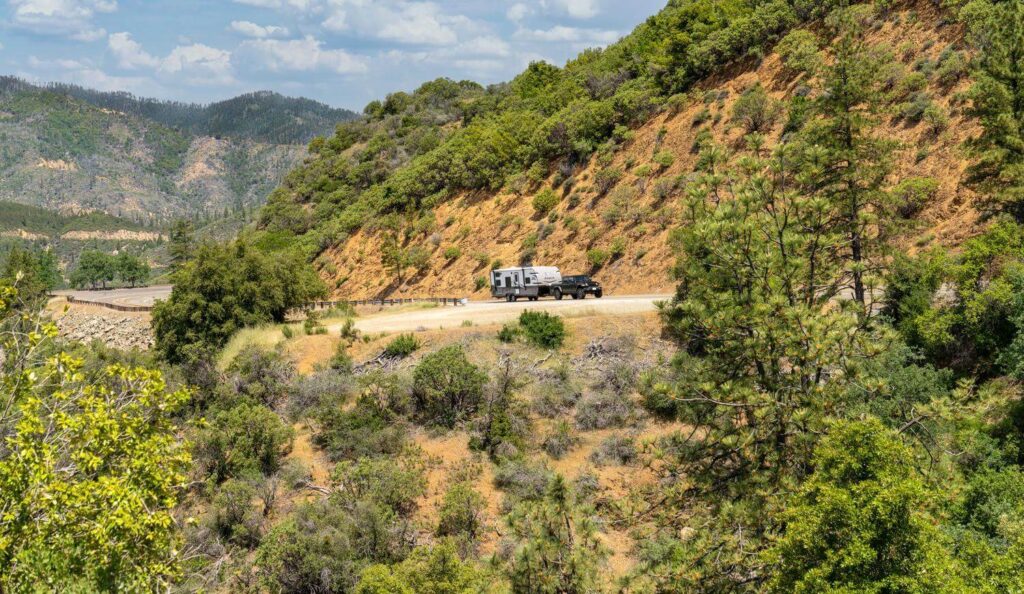
There are two main issues when towing in the mountains: overheating your vehicle and trailer brakes on descents, and overheating the engine on ascents.
Climbing Mountain Roads
When towing a travel trailer up steep mountain grades, you must accept that you will go much slower than normal. If you’re well below the posted speed limit, move to the furthest lane to the right and consider turning on your hazard signals to warn other drivers.
Take your time on steep inclines to reduce the strain on your engine, drivetrain, and transmission. On long mountain grades, you may need to stop periodically to allow your engine to cool. Keep an eye on the engine temperature gauge and pull over if it starts to rise above normal levels.
Descending Steep Grades
When descending steep grades, use your transmission to assist the braking systems on your tow vehicle and trailer. Downshift early to prevent your trailer from reaching high speeds that will require more brake application. It’s smart to maintain a slower average speed than to allow your trailer to speed up dangerously. The latter puts unnecessary strain on your braking system as it slows you back down to a safe speed.
Furthermore, avoid riding your brakes for a long period of time on a descent. Depress them to bring your speed well below the posted limit and then let off again. Constant braking accelerates brake wear and increases heat buildup.
Plan Gas Stops

Even refueling, which is normally quite simple, can be challenging when towing a travel trailer. That’s why many experienced RV owners use a trip planning app to identify gas stops in advance. The best gas stations for RV stops will offer ample space to pull in and out of pumps, and some will add amenities like dump stations, pet walks or enclosed runs, and even overnight sites with RV hookups.
Travel centers and truck stops along major highways won’t be hard to find, but advance planning can also help you find navigable gas stations in more remote locations.
Defensive Driving is Your Friend
As a final word, always practice defensive driving when towing an RV trailer. It takes longer to execute any maneuver when towing. Keep a watchful eye for other drivers and start moving over a few miles before your exit.
From experience, it’s always safer to pass an exit than to make a quick, last-minute maneuver to get off the highway. There is always another exit ahead, and a slight delay is better than an accident.
With the right preparation, a little practice, and diligence on the road, you can tow safely wherever you go. Here are a few more useful RV hitch and towing resources:
- RV Towing Essentials
- Choosing the Best Trailer Brake Controller
- Do You Need a Trailer Sway Control Kit?
Do you have questions or recommendations about safe RV towing? Let us know in the comments below!
The post Travel Trailer Towing Safety Basics appeared first on Camping World Blog.