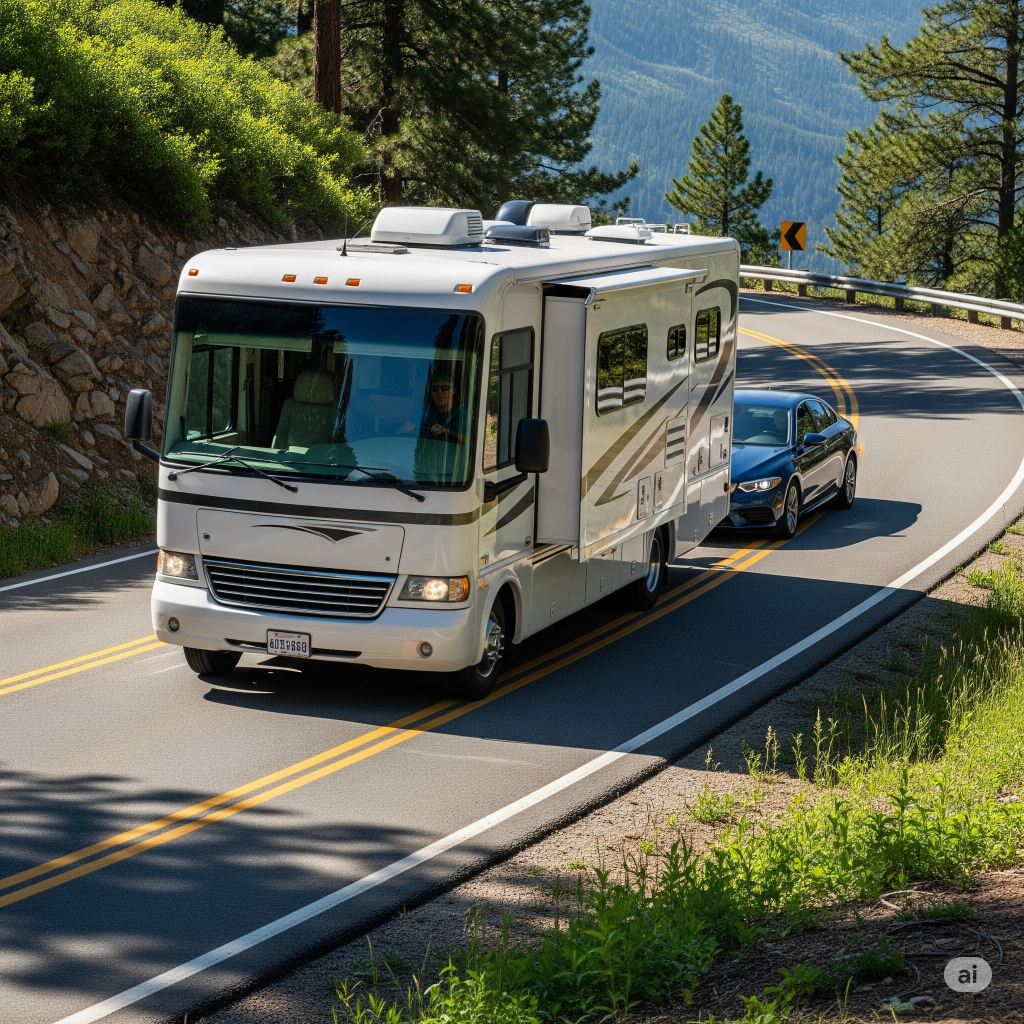
Is Dinghy Towing Behind Your Motorhome a Good Idea?
If you drive a large motorhome, you know how challenging it can be to run errands or go sightseeing.
Parking and navigating in a big rig can turn simple tasks into major ordeals. That’s why many RVers choose to bring a passenger vehicle along.
There are three main ways to tow a vehicle: trailer towing, dolly towing, and dinghy towing (also called flat towing).
The easiest and most popular method is dinghy towing, where all four wheels stay on the ground.
Dinghy towing is convenient because it requires less equipment than the other methods.
Just hook up your vehicle, set up the auxiliary braking system and signal lights, and you’re ready to go.
When you reach your destination, you can unhook and use your vehicle within minutes.
This 2025 Dinghy Towing guide covers everything you need to know to safely flat tow a vehicle behind your motorhome.
Know Your Motorhome’s Towing Capacity
Before you start dinghy towing, check your RV’s towing capacity. Overloading the chassis is unsafe and can shorten your RV’s lifespan.
You’ll find the towing capacity in the chassis manual or on a label inside your RV.
A motorhome’s tow rating is:
“The maximum weight limit that can safely be towed by your specific vehicle. This weight is calculated by adding the RV’s gross vehicle weight (GVW) with the weight of all passengers, cargo, and liquids in your tow vehicle.” — Lichtsinn RV
Choose a Vehicle for 2025 Dinghy Towing
Not every vehicle can be flat towed. In fact, many newer vehicles lack the right transmission for dinghy towing.
Typically, you’ll need a rear-wheel-drive vehicle with a manual transmission or a 4WD truck/SUV with a transfer case that can be set to neutral.
Towing the wrong vehicle can cause serious drivetrain damage.
Manufacturer-Approved 2025 Dinghy Vehicles
All vehicles listed here are 2025 models. Other, older models may be dinghy-towable, but you’ll need to check with the manufacturer beforehand to make sure.
Do NOT assume that because a model is towable one year that it will be dinghy-towable the next. Approved vehicles can change quickly and often.
Certain vehicles have restrictions on the speeds at which they can safely be towed.
Many also have special instructions that are required by the manufacturer before you hit the road (or while you’re in route).
Not only that, but only certain versions of some models listed can be flat towed.
Bottom line: It’s essential to check your prospective dinghy vehicle’s owner’s manual for towing instructions BEFORE you dinghy-tow it.
You’ll find a chapter about how to tow in the manual that comes with every vehicle. It may refer to “dinghy towing,” “flat-towing,” or even “recreational towing.”
Manufacturer-Approved 2025 Vehicles for Dinghy Towing
Listings compiled by Thomas Gowdin
Buick
- Encore GX AWD
- Envista
Cadillac
- Escalade V (with a two-speed transfer case that has a neutral and a 4WD Low)
- Escalade ESV 4WD (with a two-speed transfer case that has a neutral and a 4WD Low)
- Escalade 4WD (with a two-speed transfer case that has a neutral and a 4WD Low)
Chevrolet
- Blazer 4WD (with a two-speed transfer case that has a neutral and a 4WD Low)
- Colorado 4WD (with a two-speed transfer case that has a neutral and a 4WD Low)
- Silverado 1500 4WD (with a two-speed transfer case that has a neutral and a 4WD Low)
- Silverado 2500/3500 HD 4WD (with a two-speed transfer case that has a neutral and a 4WD Low)
- Suburban 4WD (with a two-speed transfer case that has a neutral and a 4WD Low)
- Tahoe 4WD (with a two-speed transfer case that hasa neutral and a 4WD Low)
- TRAX
- Trailblazer AWD
Dodge
- Durango (AWD with two-speed transfer case)
Ford
- Bronco (N/A Bronco Sport)
- Edge 2.7L Ecoboost
- Ford Escape Full Hybrid Electric Vehicle (FHEV)/Plug-in Hybrid Electric Vehicle (PHEV)
- Expedition 4WD
- F-150 4WD
- Super Duty 4WD
- Maverick Hybrid Electric Vehicle (HEV)
- Ranger 4WD
GMC
- Canyon/Canyon Denali 4WD (with a two-speed transfer case that has a neutral and a 4WD Low)
- Sierra/Sierra Denali 1500 4WD (with a two-speed transfer case that has a neutral and a 4WD Low)
- Sierra/Sierra Denali 2500HD/3500HD 4WD (with a two-speed transfer case that has a neutral and a 4WD Low)
- Yukon/Yukon XL/Denali 4WD (with a two-speed transfer case that has a neutral and a 4WD Low)
Jeep
- Gladiator 4WD
- Grand Cherokee 4WD (with 4WD Low)
- Wagoneer/Grand Wagoneer 4WD (with 4WD Low)
- Wrangler 4WD
Lincoln
- Corsair Plug-in Hybrid Electric Vehicle (PHEV)
- Nautilus Full Hybrid Electric Vehicle (FHEV)
- Navigator 4WD
Nissan
- Sentra (manual transmission)
- Versa Sedan (manual transmission)
- Z (manual transmission)
RAM
- 1500 4WD
- 2500 4WD
- 3500 4WD
Dinghy Towing Setup
For a safe and successful dinghy-towing experience, you’ll need some additional specialized equipment beyond simply a motorhome with a hitch receiver that can safely handle the weight of the towed vehicle:
- Base plate
- Tow bar
- Safety cables or chains
- Breakaway switch and cable
- Auxiliary braking system
- Wiring harness for signal lights or wireless magnetic LED lights
- Rock guard (optional, for debris protection)
Base Plate
A base plate provides a secure attachment point on the dinghy vehicle for the tow bar. Some installations require cutting the vehicle’s trim.
If you’re not comfortable installing it yourself, shop around for a qualified RV technician. Base plates are vehicle – and tow bar-specific.
Popular brands include Blue Ox, Curt, Demco, and Roadmaster.
Tow Bars
The tow bar connects your towed vehicle to the motorhome. It should be easy to hitch and unhitch, and lock securely while towing.
Some tow bars come with removable tabs, while others (like Demco) offer tabless options.
Tow bars are available in different weight capacities, so choose one that matches your vehicle. Many can be folded out of the way when not in use.
Blue Ox, Demco, Roadmaster, and Curt all make reliable tow bars.
Safety Cables or Chains
Safety cables or chains are essential in case your towed vehicle becomes detached. Top brands include Blue Ox, Curt, Demco, Reese Towpower, and Roadmaster.
Breakaway Switches
A breakaway switch activates your dinghy vehicle’s brakes if it becomes detached. It’s required by law in many states and Canadian provinces.
Auxiliary Braking Systems
A braking system in your towed vehicle ensures smooth, even stops. Most states and Canadian provinces require them.
Popular brands include Blue Ox, Brake Buddy, Roadmaster, Demco/SMI, and RVi.
Rock Guards
Rock guards protect your dinghy vehicle from debris. The three types of rock guards include brush, split, and solid guards. Choose the type that best fits your needs.
Signal/Tail Lights
You can install a wiring harness to connect your vehicle’s tail lights to your RV, or use wireless LED tail lights that attach magnetically.
Wireless options are easy to use and repeat your RV’s signals.
Dinghy Towing is the Way to Go!
Dinghy towing makes RV travel more convenient. You won’t need to break camp to explore or run errands, and you’ll have a passenger vehicle ready for local trips.
With the right setup, dinghy towing is safe and straightforward. Invest in quality equipment and follow manufacturer guidelines for a smooth experience.
Need more?
- 2024 Dinghy Towing Guide
- RV LIFE Releases Exclusive 2025 Guide to Trailer Towing
- Can You Increase a Vehicle’s RV Tow Rating?
The post 2025 Dinghy Towing Guide: An RV LIFE Exclusive appeared first on RV LIFE.