HAVE YOU considered hitting the road in one of the best RVs for a single person?
There are thousands of “solo travelers” who have thrown their inhibitions aside and jumped into RVing with both feet, and we want you to become one.
Today, we’ll take on the very real fears those of us who travel alone have regarding our RVs breaking down while we’re traveling.
Join us and learn how to handle RV maintenance on the road as a solo traveler.
Regular RV Maintenance

My father refused to take me to get my driver’s license at the age of 16 until I could show him I knew how to change a tire, perform an oil change, and tune up my car.
I realized (begrudgingly) that it was sound advice, as I learned to take good care of a vehicle I depended upon.
As a motorhome owner, I’m not suggesting that you become an RV mechanic, but implementing regular maintenance on your rig will help you avoid costly repairs and breakdowns on the road.
And because you are a solo traveler, you cannot pass off this responsibility to anyone else.
You don’t have to do the maintenance yourself, but you should be aware of the systems in your recreational vehicle that need consistent care.
Here’s a generic checklist to give you an idea (feel free to add your own specific items):
- Oil change on vehicle engine (for motorhomes every 3,000 to 4,000 miles)
- Oil change on a generator (about every 100 to 150 hours of usage)
- Top off water in lead-acid batteries (both chassis and house batteries)
- Run the generator monthly with a partial load
- Check tire pressure and sidewalls
- Complete an RV roof inspection and maintain a good roof surface and seams
- Check slide-out seals
- Check fresh, gray, and black water tanks for leaks and use proper chemicals
- Winterize your RV before freezing temps
- Dewinterize your RV after the spring thaw
- Sanitize RV fresh water system annually
- Check the water pump
- Maintain RV awning(s)
- Change the air and any hydraulic filters
- Check brakes
- Check electrical connections with trailers and tow vehicles
If you decide you can do some of these common maintenance requirements yourself, that’s great. If not, take your list to your RV mechanic to ensure they’ve gone over everything before you hit the road. That will definitely give you more peace of mind.
Read our complete RV maintenance checklist for pre-and post-trip, seasonal, and annual checks, and download our maintenance handbook to track your service records.
Sudden RV Repairs

Breakdowns and system failures are inevitable, and they tend to happen at the worst possible moment.
As a solo traveler, that can feel heavier, since there’s no one else to share the worry or the decision-making. A little preparation goes a long way toward making that uncertainty easier to sit with.
A roadside assistance plan is worth having in place before you need it, rather than scrambling once you’re stranded.
Providers like Good Sam cover the basics — tire changes, towing, on-the-road repairs — and some also offer add-ons like emergency medical assistance, tire and wheel protection, and various insurance options if you want more coverage.
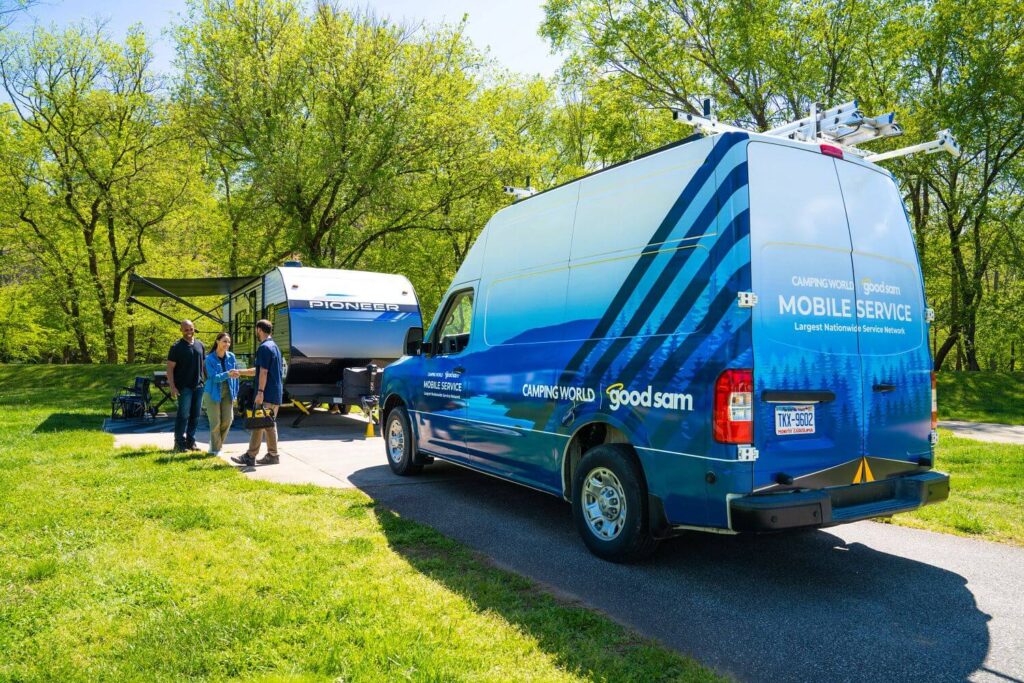
Mobile RV repair is another thing worth knowing about.
These technicians come to you, handle a wide range of system repairs, and many are happy to walk you through what they’re doing so you pick up a few maintenance skills along the way.
Camping World runs mobile service at select locations, which spares you the hassle of getting a rig to a shop — a certified tech comes to your campsite, driveway, or storage unit and repairs what they can on-site.
Not everything can be fixed this way, and pricing varies by location and issue, so it’s worth understanding what a mobile RV technician can typically fix on-site and what mobile service typically costs before you’re in a bind.
If you want to go this route, call your local Camping World to check availability and schedule; any diagnostic and travel fees are explained upfront.
One common worry is where you’ll stay while your motorhome or trailer is in the shop. Many repair shops let you sleep in your unit overnight in the lot or at an on-site campground — one less thing to figure out.
Where to Find RV Maintenance Near Me
No matter how much you can handle on your own, there may come a time when you need the assistance of a certified RV technician. That’s when you should explore RV service centers near you.
Luckily, Camping World’s nationwide service network makes it easy to find a service center when you need one.
Pro Tip: There are many benefits of becoming a Good Sam member. But when it comes to RV maintenance, you’ll receive priority service at our nationwide service locations. Explore Good Sam membership today.
RV Maintenance and Repair Education

Being aware of maintenance and repair issues that may arise in the future will give you a sense of security, knowing you are as prepared as you can be when traveling.
Go through your owner’s manual and familiarize yourself with your RV’s major systems, such as your water system, water heater, and electrical system.
Learn how to check the water in your batteries so that you can enjoy boondocking without worry.
Carry extra fuses, coolant, and distilled water with you, and learn how your electrical and water systems work so you can trace a problem back to its source.
You should also have the right tools in your RV to handle maintenance as it arises.
Download our RV tools checklist for guidance on the tools and supplies to stock in your RV.
Watch YouTube videos to learn from others who have dealt with repairs in the past, and don’t be too proud to ask for assistance when you need it.
I still have a bit of a problem putting too much pressure on myself to “handle” it all alone. When something needs to be fixed, I’ve found so many people who step forward to offer assistance that it is humbling.
The Camping World Tutorials YouTube playlist is a great resource for learning more about RV maintenance. Their RV Basics playlist is a great place to start if you’re new to RVing.
The How To Playlist has some great videos on improving A/C efficiency, winterizing and dewinterizing, and sanitizing youre fresh water system.
The RV Modifications playlist is excellent when you’re ready to upgrade your camper, and the Troubleshooting playlist is the perfect tool to help you solve issues with your power tongue jack, furnace, entrance door, and other RV components.
Traveling in an RV alone is no more daunting than living in a house alone. There will always be things that need fixing or attending to in both, so learn what you can about your new recreational vehicle and get help for the things that are out of your wheelhouse. Then take on the open road with abandon and enjoy seeing the country from the camping vantage point.
What do you think about traveling solo? Did you find this advice helpful? Leave a comment below.
The post Solo Travel – How To Handle RV Maintenance on the Road appeared first on Camping World Blog.