Choosing a trailer over a motorhome is a step towards your perfect RV. But your next decision requires a 5th wheel vs travel trailer comparison, which can be daunting for new RVers. From features to towing recommendations to full-time living considerations, here’s everything you need to know to decide which RV type works best for your lifestyle.
What Is a Fifth Wheel vs a Travel Trailer?


Images by Camping World
Fifth wheels are towable RVs that connect to a hitch in the bed of a truck. You must tow fifth wheels with trucks because of this design. The front is called a cap, and the pin box (the part of the RV that connects to the truck) is underneath the cap. This makes it simple for the owner to back up underneath the front cap and secure the pin box to the hitch in the truck bed. Some RVers prefer a ball hitch and gooseneck connection, but the setup is the same.
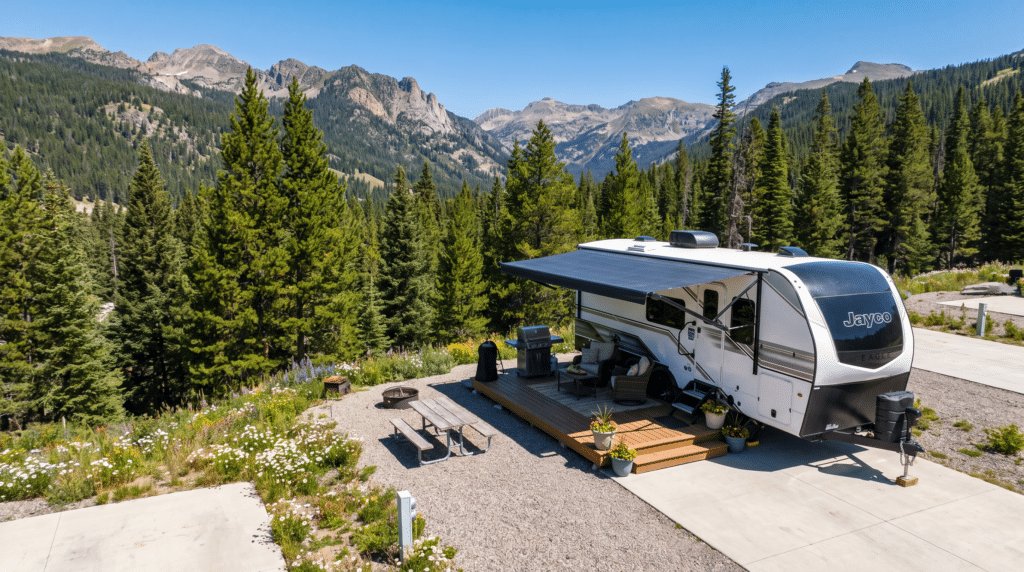
Travel trailers are towable RVs that connect to a hitch receiver under the bumper of the tow vehicle. You don’t have to own a truck to tow a travel trailer. The best lightweight travel trailers can be towed with large sedans, minivans, or SUVs. Because travel trailers don’t sit in the truck bed like fifth wheels, there are more tow vehicle options.
5th Wheel vs Travel Trailer Pros and Cons
The main advantage of owning a towable RV over a motorhome is the ability to park, detach the camper, and drive away. You don’t have to take your trailer to the grocery store, trailhead, museum, or wherever else you visit while camping.
Another advantage is that the interior is 100% livable space. In a motorhome, you have the front cab where you drive. That takes up precious space when you’re already limited. Towable RVs tend to offer more square footage for the same size because there’s no cockpit.
There are also pros and cons to fifth wheels vs travel trailers.
5th Wheel Pros and Cons
Advantages
- Larger size. Fifth wheels offer spacious living areas, kitchens, and bedrooms. The ceilings are higher, making the space feel even larger. Luxury fifth wheels can feel like an upscale apartment with residential appliances and solid wood finishes.
- Easier to tow. Because 5th wheels sit in a truck bed, the weight is more evenly distributed on the tow vehicle. This makes it easier to back up and navigate turns. There’s less sway and more control.
- Shorter total length. Even with longer 5th wheels, the total length from the truck’s front bumper to the rear of the RV is shorter because several feet of the front cap sit over the truck bed. Instead of 35 feet attached to the vehicle’s bumper, it might be 27 feet behind the truck and 8 feet over the truck bed.
- More outdoor storage. Because of the front cap design, fifth wheels are taller. This provides excellent outdoor storage bays. You’ll usually find storage underneath the front cap where the batteries are stored, a spacious pass through storage bay at the front of the RV, and more storage in the rear.
- More amenities. Since fifth wheels are generally larger, they can offer more amenities, such as a kitchen island, washer-and-dryer hookups, multiple sleeping areas, residential appliances, and more.
Disadvantages
- Larger size. While more interior space is advantageous, it can make it harder to find the right vehicle for towing a camper. Heavier 5th wheels require heavy-duty trucks, which are costly to purchase and maintain. Fifth wheels are also taller, so you have to plan driving routes carefully to avoid low clearances.
- More expensive. Overall, fifth wheels are more expensive than travel trailers. There are budget-friendly options, but you’ll lose some amenities and space.
- You lose truck bed storage. Because a fifth wheel hitch is bolted into the truck bed, you lose truck bed storage space, even when disconnected. It’s cumbersome to remove the hitch before running to the store, and the hitch itself is heavy.
- Hitch installation is more difficult. 5th wheel hitches require professional installation. The setup is more complicated than the simple ball-and-hitch setup of a travel trailer because it’s bolted to the truck bed.
- Less spontaneity. Because of their larger size, fifth wheels may make it more difficult to access certain campgrounds. Most aren’t built for off-road towing, and driving to more remote locations is difficult because of the added height and length.
Travel Trailer Pros and Cons
Advantages
- Lightweight. Because travel trailers are usually lighter than fifth wheels, you have more towing options. If you own an SUV or larger sedan, you might not have to upgrade to a truck if you find a travel trailer that fits your vehicle’s towing capacity.
- Smaller size. Travel trailers can be more aerodynamic because they have a smaller height profile than fifth wheels. Their smaller length and height can also give you more campground options, especially in national parks or boondocking spots.
- Maintain truck bed storage. You still have full use of the truck bed or easy access to an SUV’s hatch. Since travel trailers offer less storage, this is essential when hauling your camping gear.
- Easy to install the hitch ball. Because a hitch ball isn’t permanently attached to the vehicle, installation is simple, easy, and cheap. Once you’re back home, you can quickly remove the ball and set it aside until your next trip.
- Cheaper. Travel trailers are generally cheaper than 5th wheels. This is one reason they’re the best-selling type of RV. They fit within most RVers’ budgets and still offer all the essentials for comfortable camping.
Disadvantages
- More difficult to tow and control. Since a travel trailer is attached to the very end of a vehicle, it’s more difficult to control while towing. You have increased sway because most of the tongue weight is behind the rear axle unless you install a weight distribution hitch.
- Smaller size. There’s less living space, smaller bathrooms and bedrooms, and fewer storage options. For families, sometimes this is the deal-breaker when choosing between a 5th wheel and a travel trailer.
- Fewer amenities. A travel trailer generally won’t offer the same amenities as a 5th wheel. Smaller, more affordable campers will only have the basics. While there are certainly luxury travel trailers with high-end finishes, their trim packages generally offer less than what you’ll get with a fifth wheel.
Overall, a fifth wheel will feel more like home, but you’ll make sacrifices like losing spontaneity and using your truck bed. Small travel trailers can easily fit in tight spaces and offer more flexibility. If you decide to go big, 5th wheels have significant towing advantages, not to mention often offering more interior living space. But if you’re over 35 feet long, you’ll have more trouble fitting into some campgrounds with size restrictions.
Fifth Wheel vs Travel Trailer Towing Considerations


Images by Camping World
Now that you understand the pros and cons of travel trailers vs 5th wheels, your choice may come down to what your vehicle can tow. Our Towing Guide is a great resource to check overall towing capacity, but you’ll also need to consider your payload capacity.
When fully loaded, your fifth wheel or travel trailer must weigh less than your vehicle’s rated payload and towing capacities.
Technician Tip: Many experienced owners adhere to the 80% rule: When fully loaded with cargo and liquids, your trailer’s gross vehicle weight (GVW) and hitch or pin weight should not exceed 80% of your vehicle’s rated towing and payload capacities.
Here are a few more resources to help you tow safely:
- Learn more about the CURT® TruTrack
 4P distribution hitch for travel trailers.
 - Check out our fifth wheel tow hitch buying guide.
- Be confident hooking up your fifth wheel.
Fifth Wheel vs Travel Trailer for Full-Time Living
When your RV is your home, the tradeoffs between a fifth wheel and a travel trailer carry more weight. Here’s how the two stack up:
Space and livability are where fifth wheels have the clearest advantage for full-timers. Having the living area on the main floor and the bedroom elevated over the hitch (a common 5th wheel layout) creates separation between spaces that travel trailers rarely replicate. Residential appliances, kitchen islands, and washer/dryer hookups are standard in most full-time-capable fifth wheels. If you’ve compared working from a travel trailer dinette to a true desk setup in a 5th wheel, you understand why the latter generally does these livability features better.
But travel trailers have closed the gap considerably. Full-time travel trailers offer tank capacities, residential appliances, and floor plans that compete directly with fifth wheels. If you’re a solo traveler or a couple who values flexibility, the ability to tow with a half-ton rather than a heavy-duty truck makes travel trailers feel more viable as full-time homes.
To see how that gap has closed, read our guide to the best travel trailers to live in full-time.
Cost is the other major full-time consideration. Entry-level fifth wheels start around $35,000 new, but you’ll pay much more for a full-time capable rig. Plus, they typically require a more expensive truck. Travel trailers start considerably lower, and many full-time-capable models land in the $30,000 to $50,000 range new. On a per-square-foot basis, fifth wheels often deliver more value at the higher end of the market, but the total cost of entry for new owners is lower for travel trailers.
Gas mileage is debatable, but the honest answer is that neither tows economically. A heavy-duty truck pulling a fifth wheel will typically return 8-12 MPG, depending on load and terrain. A half-ton truck towing a travel trailer of comparable living space will do similarly, or marginally better, because of the lighter combined weight. The bigger mileage variable is how often you move. Full-timers who stay in one place for weeks at a time will find the per-mile fuel cost largely irrelevant compared to weekend campers.
Construction quality has less to do with the RV category and more to do with the manufacturer. At equivalent price points, fifth wheels and travel trailers from reputable brands are built to comparable standards. Fifth wheels use more substantial framing at the front cap and bedroom area, but this reflects the structural demands of the bi-level layout rather than an inherent quality difference.
Travel Trailer vs 5th Wheel RV Buying Guide
We can’t pick out the perfect camper for you, but we can help you consider important factors to determine whether a travel trailer or 5th wheel is best for your camping needs.
Select Your Ideal RV Size


Images by Camping World
Fifth wheels and travel trailers vary in length. Fifth wheels generally range in length from 25 to 45 feet, so you’ll be committing to a fairly large camper. Due to their size, they require a more powerful truck to tow, but their increased length and elevated front area make them feel more residential, which is what many desire for full-time RV living or long road trips.
Amenities like dishwashers, electric fireplaces, and washer-dryer units are not uncommon in fifth wheels. Many have kitchen islands and high-end finishes like solid wood cabinetry and solid surface countertops. But all of these amenities come with a higher price tag. You’ll need to consider your budget and decide what must-haves are on your list.
But what if you don’t have a truck? Are you worried about fitting in national park campgrounds? Or maybe you just want to tow something smaller?
Travel trailers range in length from 12 to more than 35 feet. A large travel trailer offers the same roomy feel of a fifth wheel, often at a much more affordable price. If you’re looking for a lightweight RV you can tow with a smaller vehicle like an SUV, a travel trailer is the way to go. In all cases, your camper’s gross vehicle weight (GVW) should never exceed your vehicle’s max towing capacity. You never want to push your limits.
RV Expert Tip: Don’t forget there are also excellent used RVs where you can get more bang for your buck.
Consider Driveability

With the exception of the best small travel trailers, most RVers who have towed both feel that fifth wheels are easier to maneuver and safer to tow. Why? It has to do with where the hitch point is located.
Because fifth wheel hitches are placed just forward of your truck’s rear axle, they provide a better turning radius, distribute weight better, and reduce sway. A travel trailer’s low hitch point at the vehicle’s rear means a wider turning radius and increased susceptibility to wind and sway.
If you love a travel trailer, you can purchase sway control accessories to improve weight distribution, reduce sway, and improve towing stability. Of course, very small travel trailers are the easiest to tow and maneuver.
If you’re new to RVing and have never towed a trailer before, there is a learning curve to towing either a travel trailer or a fifth wheel. The larger the size, the more difficult it is to control. And if you need a camper over 30 feet long, we suggest going with a 5th wheel if your budget allows.
Account For Total Rig Length


Images by Camping World
Consider the total length of your RV and tow vehicle before purchasing. Why? Because it may impact your campground selection. Many campgrounds have length restrictions based on site size and type — pull-through vs back-in campsites.
When selecting your ideal travel trailer vs fifth wheel, total length doesn’t always equal the RV length plus the vehicle length. With a fifth wheel, you can enjoy the same RV length while reducing the overall length, potentially expanding your campground selection.
In other words, let’s take two scenarios. In both cases, our tow vehicle is a 22’ Chevy® 2500, and our RV is 35 feet long. With a 35’ travel trailer, your total length would be 57 feet. With a 5th wheel, your overall length would likely range from 50 to 52 feet, depending on the truck’s bed size.
A reduction in total length of 5-7 feet may not seem like much, but it can be the difference between fitting in your dream campground and settling for your second choice. Additionally, you may find it easier to maneuver in and out of busy, often crowded gas stations and parking lots. While a 35’ travel trailer and 35’ fifth wheel may fit into the same campsite, the ability to get in and out of places along the way is worth considering.
Make a Budget


Images by Camping World
Finally, let’s examine how fifth wheels and travel trailers differ in price. Travel trailers are the least expensive way to start RVing. You’ll find new RVs starting just under $12,000, but as with all RV types, there are entry-level travel trailers and more expensive models with luxury features. Conversely, the most affordable new fifth wheels start at around $35,000.
When budgeting, you must consider your tow vehicle and what you can safely tow. You’ll find more lightweight travel trailers that don’t require a heavy-duty truck for safe towing. While some half-ton trucks are rated to tow the most lightweight 5th wheels, most will require a full-size truck with a higher towing capacity.
Both require additional hitches and tow equipment to be towed safely. Fifth wheels have a unique king pin design that requires a fifth wheel hitch in the truck bed, while most travel trailers require a weight distribution hitch.
The bottom line? When setting your ideal RV budget, factor in the cost of the RV, whether or not you’ll need to upgrade your tow vehicle, and the cost of additional hitch and tow equipment.
Tour Travel Trailers vs 5th Wheels In-Person
Whether you’ve chosen travel trailers or fifth wheels as your ideal RV type, your next step is touring actual floor plans in person. There are many to choose from, and this process is where the fun really begins. Keeping your vehicle’s towing capacity firmly in mind, enjoy comparing layouts and stacking up features to ultimately select the RV that checks all of your boxes.
Frequently Asked Questions
Neither is objectively better. It depends on your household size, tow vehicle, budget, and how you camp. Fifth wheels offer more space, better separation between living areas, and superior towing stability, making them the traditional choice for full-time families and couples who prioritize comfort. Travel trailers offer more flexibility, a lower cost of entry, and improved access to campgrounds and boondocking spots. For full-timers who move frequently and camp in varied terrain, a well-built travel trailer is often the smarter choice. For those who park for extended periods and want a more residential feel, a fifth wheel is worth the added cost.
Absolutely. Fifth wheels are one of the most popular full-time living choices precisely because of their residential floor plans, larger tank capacities, and dedicated bedroom separation. Most long-term full-time RV communities skew heavily toward fifth wheels. The main practical considerations are finding campsites with sufficient length and hookup access, maintaining a heavy-duty truck as your tow vehicle, and budgeting for higher fuel and maintenance costs than a smaller rig.
It depends on what you’re optimizing for. Fifth wheels win on interior space, towing stability, and residential amenities. Travel trailers win on flexibility, cost of entry, and tow vehicle compatibility. Neither type is universally better. The right answer is whichever matches your tow vehicle, your budget, and how you actually camp.
At equivalent price points from the same manufacturers, not significantly. Both types use similar framing materials, wall construction methods, and roof systems. The structural differences, such as heavier front cap framing in fifth wheels, reflect design requirements rather than a quality gap. What matters more than the RV type is the manufacturer’s construction standards and warranty.
Ready to dive into specific floor plans? See our picks for the best travel trailers of 2026.
Are you leaning towards a travel trailer or a fifth wheel? Let us know which and why in the comments below.
The post Fifth Wheel vs Travel Trailer Pros and Cons appeared first on Camping World Blog.