If you’re researching fifth wheels vs travel trailers, you know they both come in many sizes. Some can be pulled by SUVs or mid-size trucks, while others require a heavy-duty pickup truck. Most SUVs tow 5,000 to 10,000 lbs, mid-size trucks 4,000 to 7,700 lbs, full-size trucks 11,000 to 13,500 lbs, and heavy-duty trucks 20,000 to 40,000 lbs, depending on trim level.
Know your vehicle? Enter your year, make, model, and trim to see your exact towing capacity and which RVs you can tow.
Before you tour RVs in person (or online), calculate how much your vehicle can tow. If you have a specific RV type, style, or size in mind, but don’t have a vehicle to tow it yet, you’re in a perfect place to learn how to find the best vehicle to tow that camper.
Here’s everything you need to know about RV weight ratings, diesel versus gas tow vehicles, and more. Plus, enjoy our breakdown and list of the towing capacities for common tow vehicles, from SUVs to heavy-duty trucks. Let’s begin with RV weight ratings.
Start With RV Weight Ratings
Every RV has a vehicle identification sticker that provides basic information about its trailer, including weight ratings, tire size, and more. Here are a few key terms to know.
Gross Vehicle Weight Rating (GVWR)
This is the total weight the RV can handle based on its axles and tire ratings.
Gross Combined Weight Rating (GCWR)
The maximum weight allowed for the tow vehicle and the trailer when fully loaded.
Unloaded Vehicle Weight (UVW)
How much the trailer weighs as it rolls off the assembly line.
UVW—also known as dry weight—includes any of the basic amenities inside, like the dinette, sleeper sofa, theater seating, and kitchen appliances, as well as the weight of batteries and LP containers. It does not include the weight of the passengers or cargo you’ll add, nor does it factor in the liquid weight you may carry with full holding tanks.
Cargo Carrying Capacity (CCC)
The maximum amount of weight you can load into your RV. Calculate it by subtracting the unloaded vehicle weight from the gross vehicle weight rating (GVWR – UVW = CCC).
As an example, let’s say the GVWR is 3,500 pounds, and the UVW is 2,500 pounds.
3,500 – 2,500 = 1,000 pounds of cargo carrying capacity
Any accessories added during an RV renovation, plus your camping gear, will affect your RV’s cargo carrying capacity. This is why we often preach the importance of lightweight materials and packing only what you truly need.
Tongue/Pin Weight
The amount of weight exerted on your tow vehicle’s hitch ball or fifth wheel hitch. Known as tongue weight for travel trailers and pin weight for fifth wheels.
Learn more about the different types of trailer hitches.
Payload Capacity
The amount of cargo weight your tow vehicle can hold. This includes the weight of all passengers and cargo inside the vehicle and the hitch weight of your trailer or fifth wheel.
Rear Axle Weight Rating (RAWR)
The amount of weight your vehicle’s rear suspension is rated to handle.
How To Calculate Whether Your Vehicle Can Tow a Camper
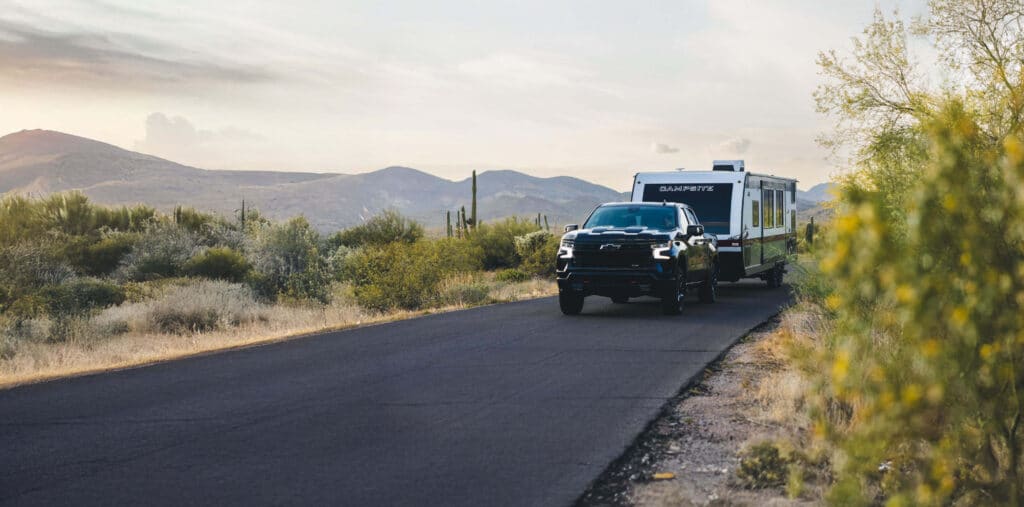
You can check almost any tow-vehicle-and-RV pairing in three steps. Let’s walk through them with the 2026 Campsite Reserve 25MW, a nearly 30-foot travel trailer with a front bedroom, rear bathroom, single slide, and outdoor kitchen.
Forest River lists a dry weight (UVW) of 6,008 lbs and a cargo carrying capacity of 1,757 lbs, which adds up to a GVWR of 7,765 lbs. Its hitch weight is 765 lbs.
Step 1: Apply the 80% Rule to Towing Capacity
Your RV’s GVWR should be no more than 80% of your tow vehicle’s towing capacity. Multiplying any trailer’s GVWR by 1.2 gives you that 20% buffer. For example:
7,765 x 1.2 = 9,318 lbs of towing capacity needed
That buffer gives you margin for mountain grades, headwinds, hot weather, and the extra gear that always seems to get packed.
Here’s where the rule earns its keep. The Dodge Durango (8,700 lbs) and Nissan Armada (8,500 lbs) can technically pull this trailer, but both would only do so while ignoring that 80% rule, placing more strain on their engine, suspension, drivetrain, braking systems, and other components.
. In comparison, the Toyota Sequoia and Ford Expedition clear that threshold, proving you don’t necessarily have to upgrade to a truck to have solid tow capability.
Step 2: Check Payload Against Loaded Tongue Weight
The 25MW’s listed hitch weight of 765 lbs is an empty number. Tongue weight rises as you load the trailer and typically lands between 10 and 15% of the trailer’s loaded weight. Planning on about 13% of GVWR gives you roughly 1,010 lbs.
Now add everything else your truck carries:
- Loaded tongue weight: about 1,010 lbs
- Weight distribution hitch: about 100 lbs (varies by model)
- Two adults plus gear in the cab and bed: about 500 lbs
That’s roughly 1,610 lbs of payload needed. Always check your vehicle information sticker or owner’s manual for your exact payload rating before settling on a camper.
Step 3: Confirm GCWR and Rear Axle Limits
Two final checks. First, tow vehicle weight + payload + loaded trailer weight must not exceed the tow vehicle’s GCWR. Second, the weight on your truck’s rear axle must not exceed its weight rating.
A travel trailer’s tongue weight sits behind the rear axle, which lifts weight off the front wheels and hurts steering and braking. A properly adjusted weight distribution hitch shifts some of that weight back to the front axle.
The most reliable way to confirm how much your entire setup weighs, and how much weight is on your rear axle, is to weigh your loaded rig at a certified truck scale before your first big trip.
Towing a fifth wheel instead?
The steps are the same, but payload becomes even more important. Fifth wheel pin weight typically runs 15 to 25% of the trailer’s loaded weight, far more than a travel trailer’s tongue weight, and it sits in the truck bed over the rear axle. Add a 150 to 250 lb fifth wheel hitch, and many half-ton trucks run out of payload before they run out of towing capacity. Pin weight must not exceed the tow vehicle’s RAWR.
Input a tow vehicle’s year, make, model, and trim (or VIN) into Camping World’s towing guide to view its maximum towing capacity and find RVs your vehicle can tow.
How to Find a Compatible Tow Vehicle

Family SUVs, minivans, and mid-size trucks are great options for towing pop up campers, teardrops, and lightweight travel trailers because they offer additional cargo space inside the vehicle or in the truck bed.
Full-size or heavy-duty pickups are preferred for towing larger travel trailers and fifth wheels because they are better built to handle the extra weight placed on the rear suspension.
With that said, let’s look at some of the best vehicles for towing a camper, including picks for the best electric vehicle for towing!
Editor’s Note: The listed weights below are for 2026 and/or 2027 models only. Actual ratings vary based on year, make, model, and trim. Please consult vehicle manufacturers for the most up-to-date tow vehicle weight ratings.
The Best SUVs for Towing a Camper
| SUV | Towing Capacity (lbs) | Payload Capacity (lbs) | What You Can Tow |
|---|---|---|---|
| Ford Bronco | Up to 4,500 | Up to 1,450 | Teardrops, pop-ups, and small travel trailers |
| Jeep Wrangler | Up to 5,000 | Up to 1,249 | Teardrops, pop-ups, and small travel trailers |
| Tesla Model X | Up to 5,000 | Up to 1,400 | Teardrops, pop-ups, and small travel trailers |
| Ford Explorer | Up to 5,000 | Up to 1,467 | Teardrops, pop-ups, and small travel trailers |
| Toyota 4Runner | Up to 6,000 | Up to 1,550 | Lightweight travel trailers and most teardrops |
| Jeep Grand Cherokee | Up to 6,200 | Up to 1,280 | Lightweight travel trailers and most teardrops |
| Audi Q7 / Q8 / Q9 | Up to 7,700 | Up to 1,268 | Most lightweight travel trailers |
| Rivian R1S (Gen 2) | Up to 7,700 | Up to 2,161 | Most lightweight travel trailers |
| Chevrolet Tahoe | Up to 8,400 | Up to 2,020 | Lightweight and some mid-size travel trailers |
| GMC Yukon | Up to 8,400 | Up to 1,540 | Lightweight and some mid-size travel trailers |
| Nissan Armada | Up to 8,500 | Up to 1,486 | Lightweight and some mid-size travel trailers |
| Dodge Durango | Up to 8,700 | Up to 1,590 | Lightweight and some mid-size travel trailers |
| Toyota Sequoia | Up to 9,500 | Up to 1,730 | Most mid-size travel trailers, but not a fifth wheel |
| Ford Expedition | Up to 9,600 | Up to 1,971 | Most mid-size travel trailers, but not a fifth wheel |
| GMC Hummer EV SUV | Up to 10,000 | Up to 1,300 | Most mid-size travel trailers, but not a fifth wheel |
| Jeep Grand Wagoneer | Up to 10,000 | Up to 1,590 | Most mid-size travel trailers, but not a fifth wheel |
The Grand Wagoneer, Hummer EV SUV, Expedition, and Sequoia top this list and can handle most mid-size travel trailers, while the 4Runner and Jeep Grand Cherokee are better matched to lightweight travel trailers and teardrops. If you’re shopping for an Explorer, its 5,000-lb rating points you toward teardrops, pop-ups, and the smallest travel trailers.
Electric SUVs tow well, but range takes a big hit: Rivian says towing at its maximum rating cuts range by about half.
Compact and Mid-Size Trucks for Towing a Camper
| Mid-Size Truck | Towing Capacity (lbs) | Payload Capacity (lbs) | What You Can Tow |
|---|---|---|---|
| Ford Maverick | Up to 4,000 | Up to 1,500 | Pop-ups and teardrops |
| Hyundai Santa Cruz | Up to 5,000 | Up to 1,738 | Teardrops, pop-ups, and small travel trailers |
| Honda Ridgeline | Up to 5,000 | Up to 1,583 | Teardrops, pop-ups, and small travel trailers |
| Toyota Tacoma | Up to 6,500 | Up to 1,680 | Lightweight travel trailers |
| Nissan Frontier | Up to 7,150 | Up to 1,590 | Most lightweight travel trailers |
| Ford Ranger | Up to 7,500 | Up to 1,788 | Most lightweight travel trailers |
| Jeep Gladiator | Up to 7,700 | Up to 1,720 | Most lightweight travel trailers |
| Chevrolet Colorado | Up to 7,700 | Up to 1,710 | Most lightweight travel trailers |
| GMC Canyon | Up to 7,700 | Up to 1,670 | Most lightweight travel trailers |
The Colorado, Canyon, and Gladiator share the top rating in this class at 7,700 lbs, with the Ranger close behind. The Tacoma is a good match for lightweight travel trailers, while the Maverick fits pop-ups and teardrops. Keep an eye on payload in this class, since tongue weight, passengers, and gear in the bed add up fast.
Full-Size Trucks for Towing a Camper

| Full-Size Truck | Towing Capacity (lbs) | Payload Capacity (lbs) | What You Can Tow |
|---|---|---|---|
| Rivian R1T | Up to 11,000 | Up to 2,172 | Most mid-size travel trailers |
| RAM 1500 | Up to 11,530 | Up to 2,340 | Mid-size and some large travel trailers |
| Toyota Tundra | Up to 12,000 | Up to 1,850 | Mid-size and some large travel trailers |
| GMC Hummer EV Pickup | Up to 12,100 | Up to 1,760 | Mid-size and some large travel trailers |
| Chevrolet Silverado EV | Up to 12,500 | Up to 2,350 | Large travel trailers and the lightest fifth wheels |
| Chevrolet Silverado 1500 | Up to 13,700 | Up to 2,340 | Large travel trailers and the lightest fifth wheels |
| GMC Sierra 1500 | Up to 13,500 | Up to 2,310 | Large travel trailers and the lightest fifth wheels |
| Ford F-150 | Up to 13,500 | Up to 2,440 | Large travel trailers and the lightest fifth wheels |
The F-150, Silverado 1500, and Sierra 1500 can pull large travel trailers and select fifth wheels. Just remember that payload runs out fast, and a half-ton truck’s fifth wheel tow rating is often a couple thousand pounds lower than its conventional tow rating.
Heavy-Duty Trucks for Towing a Camper

| Heavy-Duty Truck | Towing Capacity (lbs) | Payload Capacity (lbs) | What You Can Tow |
|---|---|---|---|
| RAM 2500 | Up to 20,000 | Up to 4,580 | Most fifth wheels and toy haulers |
| Chevy Silverado 2500HD | Up to 19,000 | Up to 3,979 | Most fifth wheels and toy haulers |
| GMC Sierra 2500HD | Up to 22,390 | Up to 3,863 | Most fifth wheels and toy haulers |
| Ford F-250 | Up to 23,000 | Up to 3,730 | Most fifth wheels and toy haulers |
| Chevy Silverado 3500HD | Up to 38,000 | Up to 6,990 | The heaviest fifth wheels and toy haulers |
| GMC Sierra 3500HD | Up to 36,000 | Up to 7,290 | The heaviest fifth wheels and toy haulers |
| RAM 3500 | Up to 36,610 | Up to 7,590 | The heaviest fifth wheels and toy haulers |
| Ford F-350 | Up to 38,000 | Up to 7,164 | The heaviest fifth wheels and toy haulers |
| Ford F-450 | Up to 40,000 | Up to 5,917 | The heaviest fifth wheels and toy haulers |
A 2500-series truck like the F-250, Silverado 2500HD, or RAM 2500 handles most fifth wheels on the market, while 3500 and F-450 dually trucks are built for the heaviest luxury fifth wheels and toy haulers. The top ratings typically require a diesel engine, a gooseneck or fifth wheel hitch, and a specific cab and axle configuration.
For configuration-level ratings, see the 2027 Ford RV & Trailer Towing Guide and the 2026 Ram Heavy Duty payload and towing chart.
Is a Diesel or Gas Tow Vehicle Better?
There’s a lot of heat in the gas versus diesel debate. Diesel engines offer excellent towing power and are geared to handle heavy loads. You can take inclines with a loaded fifth wheel while hardly slowing down. Additionally, most dually trucks are built with diesel engines, meaning that you’ll likely only find diesel options if you’re looking for a truck with a higher payload and towing capacity.
It was once true that diesel tow vehicles had much higher maintenance costs, but newer gasoline models can be just as expensive.
Newer gas engines also still pack plenty of power. Their gear ratios may mean you slow down more on steep inclines, but many see nothing wrong with that. For some, it simply comes down to differences in their region’s gas and diesel prices.
| Gas | Diesel | |
|---|---|---|
| Upfront Cost | Lower | Higher; the diesel engine is a significant upcharge |
| Fuel Cost | Fuel often costs less per gallon, but mileage drops more under load | Better mileage when towing, but diesel often costs more per gallon |
| Maintenance | Comparable on newer models | Comparable on newer models; adds diesel exhaust fluid (DEF) and fuel filter upkeep |
| Best Use Case | Travel trailers, lighter fifth wheels, occasional towing | Heavy fifth wheels, toy haulers, frequent or long-distance towing |
It also comes down to what you’re most comfortable driving. Find a tow vehicle that will pull your RV and one you’re comfortable driving. The last thing anyone wants is an unsafe (and uncomfortable) RVer on the road.
How To Safely Load an RV
Regardless of your RV-tow vehicle combination, you can use these tips for safe RV towing:
Follow the 60/40 Rule. Place 60% of the loaded weight in front of your trailer’s center axle and the remaining 40% behind it.
Travel with Empty Holding Tanks. One gallon of water weighs over eight pounds. Most RV fresh water tanks hold anywhere from 20-100 gallons. Depending on your model, that means you’ll carry an extra 160-800 pounds, just in fresh water weight. Alternatively, you can carry extra water in a portable water container.
Pack Efficiently. Carry only what you absolutely need for your trip. The more weight you tow, the more your gas mileage will suffer and the more strain you put on both the RV and tow vehicle.
Frequently Asked Questions
The 80% rule says your RV’s GVWR should be no more than 80% of your tow vehicle’s towing capacity. To find the capacity you need, divide the RV’s GVWR by 0.8 (or multiply by 1.25). An RV with an 8,000-lb GVWR needs a vehicle rated for at least 10,000 lbs. The buffer protects your vehicle on grades, in heat, and in wind.
GVWR. Dry weight is what the RV weighs empty from the factory, before you add water, propane, food, gear, and accessories. Once you load up, you’ll often be close to the GVWR, so matching your tow vehicle to dry weight is one of the most common ways buyers end up overloaded. Always use GVWR in your calculations.
Open the driver’s door and find the yellow Tire and Loading Information sticker. It states the maximum combined weight of occupants and cargo for your exact vehicle. That’s your payload. Brochure figures represent the best-case configuration, and options like 4×4, a larger cab, or a premium trim all reduce payload.
Towing beyond your ratings increases stopping distances, raises the risk of trailer sway, and can overheat your transmission and brakes on long grades. It also accelerates wear on suspension, tires, and drivetrain components. Beyond the safety risk, exceeding manufacturer ratings could complicate warranty coverage and insurance or liability claims after an accident.
Towing within your vehicle’s published ratings is normal use and shouldn’t affect your warranty on its own. Coverage issues can come up if damage is tied to exceeding those ratings, or if an aftermarket part causes a failure. Before towing, read the towing and warranty sections of your owner’s manual, and ask your dealer before adding aftermarket hitches or suspension upgrades.
Ensuring the safety of your towable RV starts by choosing the right tow vehicle. So here are a few more helpful resources:
- Tow Vehicles: Should You Buy New or Shop Used?
- Can a Half-Ton Truck Tow a Fifth Wheel RV?
- Everything You Need to Hitch & Tow Your RV
Do you have questions about what kind of vehicle you should get to tow your RV? Please post them in the comments below!
The post How To Find the Best Vehicle for Towing a Camper appeared first on Camping World Blog.