In an RV kitchen, every accessory has to earn its place. That’s easy to forget when there’s always another gadget promising to make camp cooking simpler. But collect enough of them and you end up hauling a camper full of stuffed drawers and cabinets packed with appliances you rarely even use. The RV cooking accessories worth owning pull their weight. Everyone’s setup is different, and the goal is to figure out what works for you. But here are a few you may want to consider.
This guide sticks to gear that solves a problem, indoors and out. A few of these upgrades bring an older galley up to the level of what new rigs now standard with, while others address common pain points among RVers. And with so many campers built with outdoor kitchens these days, we’ll provide some ideas of what to do if yours doesn’t.
Key Takeaways
- Accessories like compact air fryers bring older RVs up to speed with new models that feature those appliances standard.
- Some accessories like baking steels or pizza stones can help offset inconsistent oven temperatures that sometimes affect camp chefs.
- To cook outdoors, a flat-top griddle, a portable pizza oven, and a folding cook station let you build a full outdoor kitchen even if your RV didn’t come with one.
- Space-saving gadgets like collapsible silicone tools, nesting cookware, a sink-cover cutting board, and fridge bars reclaim counter space and keep gear secure on travel days.
Indoor RV Cooking Accessories to Upgrade an Older Kitchen
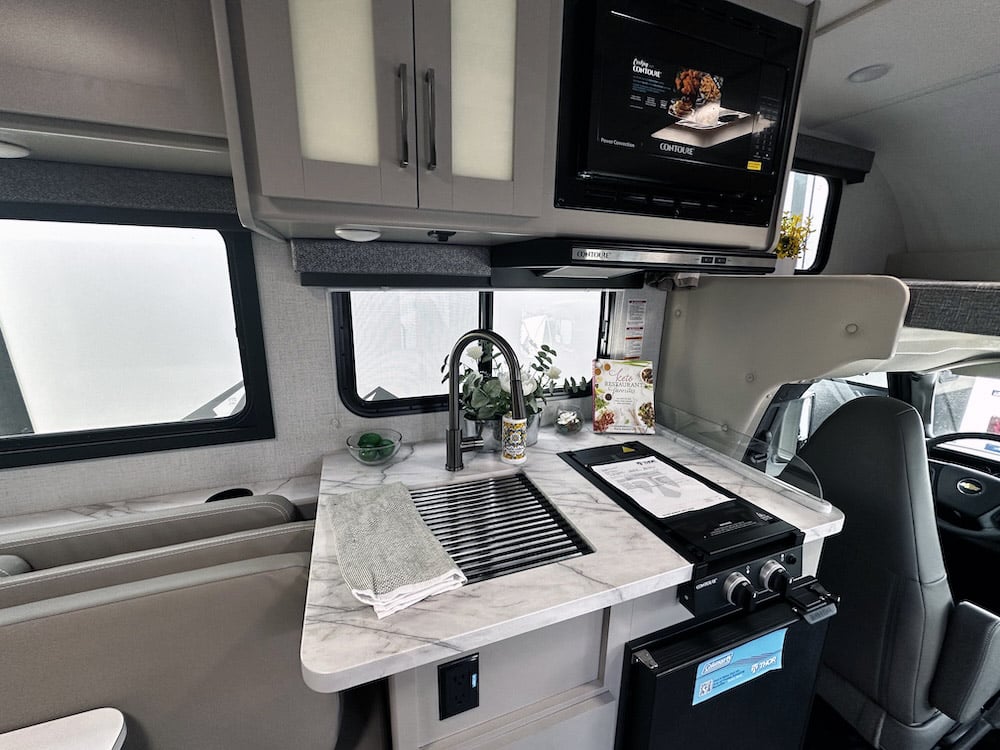
New RVs are shipping kitchens with accessories that address some of the pain points of previous generations of RVs. Induction cooktops and built-in air fryers are becoming standard equipment on 2026 models, for example. But that doesn’t mean you can’t join in on the convenience with an older camper. The good news is that you can add most of that capability to an older camper with just three RV kitchen accessories that close the gap without upgrading your coach.
Baking Steel or Pizza Stone (Plus an Oven Thermometer)
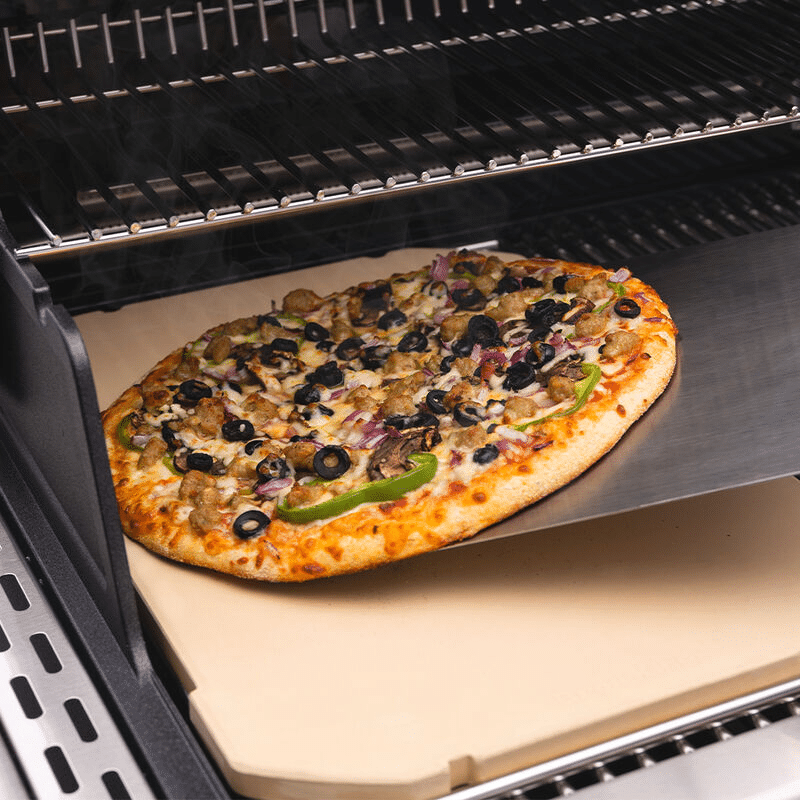
The most common complaint about RV baking is burned bottoms, and the cheapest fix is a slab of thermal mass. RV propane ovens heat from a single burner under a thin metal shield, which creates a hot spot right under your food while the edges stay cool — and the thermostats are notoriously inaccurate. A baking steel or pizza stone set on the heat shield absorbs that concentrated heat and spreads it evenly up and around the oven, so biscuits and cookies stop scorching on the bottom. It also holds temperature when you open the door, which a small RV oven otherwise loses in seconds. Pair it with a cheap oven thermometer so you know the real temperature and when the oven is actually preheated, then leave the steel in place for travel. Two small purchases turn a sometimes problematic appliance in your rig into one you’ll actually use — and enjoy.
Portable Induction Cooktop
A portable induction cooktop is the single easiest way to modernize an older galley. It boils water in a fraction of the time a propane burner takes, and because it heats the pan directly instead of the air, it doesn’t pump heat and moisture into a cabin you’re also living in — a real difference in summer. There’s no open flame, which removes one of the more common cooking hazards in a small space, and cleanup is a wipe of a flat glass top. Most units run on a standard 120V outlet, so they’re happy on shore power; just watch your total draw at a 30-amp site. One thing to know before you buy: induction only works with flat-bottomed stainless steel or cast iron cookware, so hold a magnet to your pans first — if it sticks, you’re set.
Compact Air Fryer
If your RV predates the built-in air fryer, a countertop model is the quickest way to catch up. Newer campers increasingly ship with a convection microwave that includes an air-fry function, or even a 3-in-1 oven-microwave-air-fryer — but older rigs came with a cramped propane oven and nothing else. An air fryer adds back the ability to bake, roast, reheat, and crisp on shore power, with none of the preheat-and-pray routine an RV oven demands. It only needs temporary counter space, and it may fit into a larger cabinet when not in use. For anyone who skips their built-in oven entirely — and plenty of RVers do — it quickly becomes the appliance you reach for most.
Outdoor RV Cooking Accessories

Cooking outside keeps heat, smoke, and smells out of the rig, and it’s where you’ll handle the big meals. The gear below works whether your RV has a built-in outdoor kitchen or you’re building one from scratch.
Flat-Top Griddle
If your rig has propane hookups but no built-in outdoor kitchen, a flat-top griddle is the move. The wide surface lets you cook an entire meal at once — eggs, bacon, and hash browns side by side, or a round of smash burgers for everyone — instead of juggling a single skillet on a two-burner cooktop. Models from Blackstone and Camp Chef come with two or three independently adjustable burners for real temperature control, and most connect to your rig’s onboard propane through a quick-connect fitting, so you’re not babysitting little green bottles. Because it runs on propane and not an open wood fire, it keeps working during the summer fire bans that shut down grilling elsewhere, and cleanup is a quick scrape rather than a sink full of pans. If you want to compare options, start with our guide to the best grills for camping.
Portable Pizza Oven
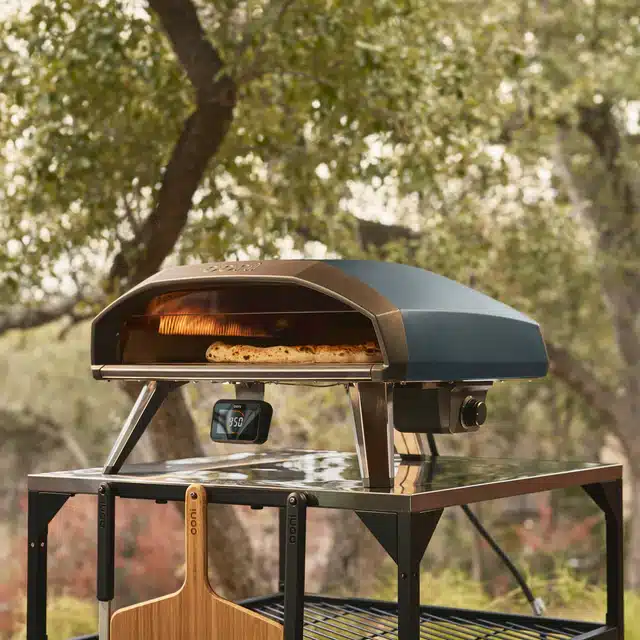
The food that makes a campsite feel like an event usually isn’t burgers — it’s the thing you didn’t think you could pull off on the road. A portable pizza oven is the clearest example. Units like the Ooni or Cuisinart outdoor ovens run off a standard propane tank, assemble in minutes without tools, weigh well under 40 pounds, and cook a fresh pie in around five minutes on a built-in stone. Fire it up at the picnic table and you’ve turned an ordinary night at the campground into pizza night for the whole loop. It stores compactly in a basement bay and earns its space by doing the one thing your RV oven can’t.
Build Your Outdoor RV Kitchen Piece by Piece
You don’t need a factory outdoor kitchen to cook like you have one — you can assemble a better setup yourself, one piece at a time. The griddle above is your cooking surface; these are the parts that turn a bare campsite into a working kitchen around it, roughly in the order you’d add them.
- Folding cook station: The anchor piece. A good camp kitchen table gives you a heat-safe spot for the griddle, fold-out side wings for prep, a lower shelf, and hooks for utensils — essentially a whole kitchen in a bag.
- Grill mount or slide-out tray: Bumper- or hitch-mount your griddle, or set it on a heavy-duty pull-out tray in a pass-through storage bay so you slide it out, connect the propane, and cook in minutes.
- Grab-and-go utensil caddy: One carrier holds your spatula, tongs, scraper, thermometer, and oil so the whole outdoor kit travels as a single unit and lives by the door.
- Rechargeable LED lanterns: A dark cook station is a useless one. A couple of warm-toned lanterns keep the counter usable well past sunset.
- Collapsible outdoor sink: A folding wash tub or extra basin keeps grease and dishwater out of your galley and off your tanks — and it flattens to a couple of inches when you’re done.
Kitchen Gadgets That Do More Than You Think
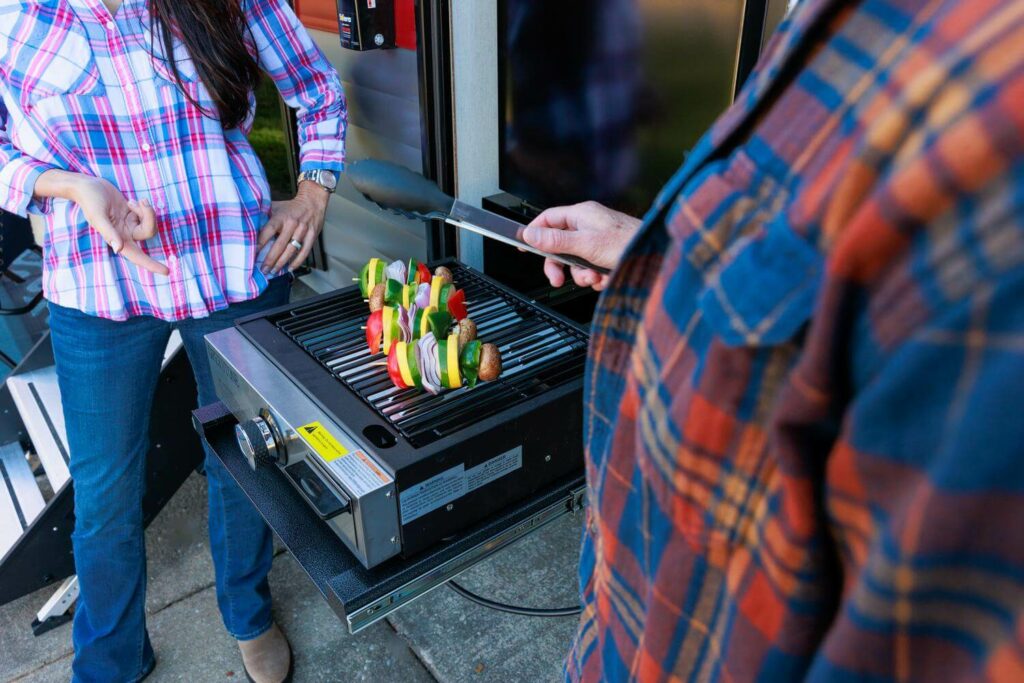
The biggest wins in a smaller galley often come from the cleverest gear — pieces that reclaim counter and cabinet space or keep everything from becoming a mess on travel day. None of these cost much, and each one solves a problem specific to cooking in a moving home.
- Collapsible silicone multi-tool set: It’s the Swiss Army knife of RV kitchens. One kit replaces a strainer, colander, mixing bowl, cutting board, and measuring cups, and the whole thing collapses flat. If you buy one space-saver, make it this.
- Nesting cookware with removable handles: A set of pots and pans that stack inside one another takes up the space of a single pot. Look for induction-compatible stainless if you’ve added a cooktop.
- Sink-cover cutting board: Counter space is the most precious thing in an RV kitchen. A board that sits over the sink gives you an instant prep surface, then lifts off when you need the basin back.
- Fridge bars and tension rods: Think of these as a seatbelt for your groceries. Spring-loaded bars hold everything in place so you don’t open the fridge at camp to find spilled milk and a broken shelf.
- Clear bins and non-slip liners: Group cabinet and fridge contents into bins you can pull out with one hand, and line shelves so nothing slides on travel day. It’s the simplest RV organization upgrade there is.
- Magnetic knife and tool strips: Mounted inside a cabinet or on an outdoor kitchen panel, they keep sharp tools secure and off your limited counter.
Frequently Asked Questions
Place a baking steel or pizza stone on the metal heat shield above the burner, below your food, and let it preheat with the oven. It absorbs the concentrated heat from the single burner and spreads it evenly, which stops the burned bottoms most RV ovens produce. Add an inexpensive oven thermometer, since RV oven dials are often inaccurate, and adjust your setting to match the real temperature.
For most RVers, yes. Induction boils water far faster than a propane burner, keeps heat and moisture out of the cabin, cleans up with a wipe, and removes the open flame from a small space. The main requirements are a 120V power source and induction-compatible cookware.
Induction only works with magnetic, flat-bottomed cookware — generally stainless steel or cast iron. The quickest test is to hold a magnet to the bottom of a pan; if it sticks firmly, the pan will work. Aluminum, copper, and most glass or ceramic cookware will not heat on induction.
A flat-top griddle is the most practical choice. Its large surface cooks a full meal at once instead of one pan at a time, and units with two or three burners let you run different temperatures for different foods. Most connect to your RV’s propane and keep working during fire bans.
Choose gear that collapses flat or does more than one job. A collapsible silicone multi-tool set, nesting cookware, and a sink-cover cutting board deliver the biggest space wins, while bins and fridge bars keep everything organized and secure while you drive.
Now that your rig is equipped and ready to go, it’s time to consider the type of RV cooking techniques and meals at your disposal.
The post These RV Kitchen Accessories Make A Difference appeared first on Camping World Blog.